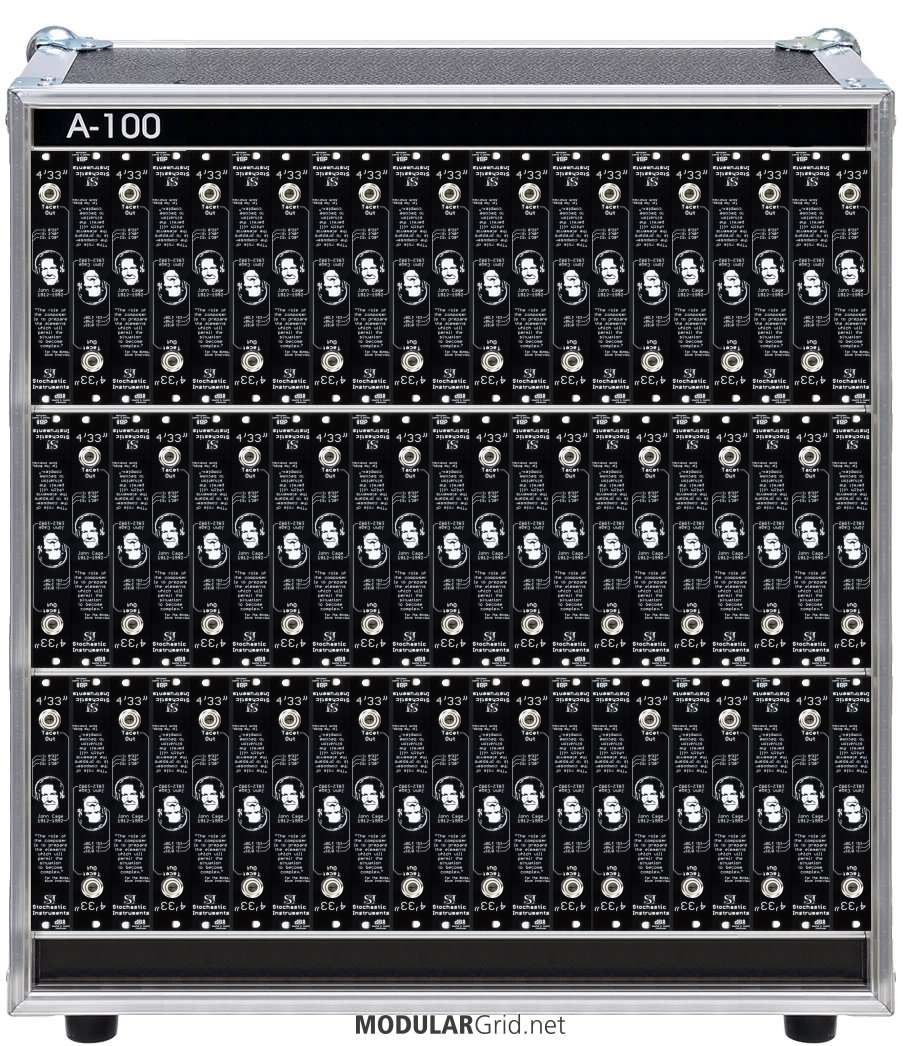
Thread: Current Live Setup
Hi @RichardDevine how do you like the Ultra Random Redux compared to the original?

Hi @RichardDevine how do you like the Ultra Random Redux compared to the original?


Daily, but maybe the API is broken, will look into it...
Beep, Bopp, Bleep: info@modulargrid.net

On individual module pages, there are listings of any for sale either on MG or on Reverb.
I'm wondering how often the Reverb ones get refreshed, as there seem to be a lot with what are basically dead links (module has long since been sold, or the reverb listing removed).

thank you for the input ! I've reviewed carefully the suggestions and yes at least one buffered mult is needed. I didn't really understood how the Frap Tools 333 can keep things in tune. I still think a matrix mixer could be nice to shape on the flow some audio and cv signals during improvisation sessions, actually this is what I am doing the most during performances.


Any resellers in EU?
I want this badly, but taxes from UK are a barrier to me.
-- VONDENFUNKEN
Now aviable at Schneiders-Laden.
OPFXS, Crazy Tube Circuits
-- KNYST
I added both
Beep, Bopp, Bleep: info@modulargrid.net

Nice case, I've been thinking about trying to make a peice of wood-art a bit like those plywood sides.
Enjoy your spare HP, don't rush to fill every last space, this is not like filling sticker books. Resist the urge to 'complete' your rack, its never complete so just relax.

Swapped out the Doepfer Precision Adder and a passive mult for a Radio Music and Clep Diaz

There are more of course, but, off the top of my head, here are two manufacturers missing on pedalgrid: OPFXS, Crazy Tube Circuits

ive just had a message about an iyrm fro sale form a user 'support23" with a link yo end bank details, thr user has recently joined, no feedback, beware!
-- Gint
same here, well done blocking/banning this user
I may have an idea to find who it is, by investigating on I.P. adresses, it could be a personn who already have a profile on here... MG is too much of a niche profile for a big scammer to focus on it. The target site is registered in U.S. but anyone could use that site to spread the shit out...
I received a scam/virus link in my PM box, the newly created profile is already blocked (well done) I may have an idea to find who it is, by comparing I.P. adresses, it could be a personn who already have a profile on here... MG is too much of a niche profile for a big scammer to focus on it.
ive just had a message about an iyrm fro sale form a user 'support23" with a link yo end bank details, thr user has recently joined, no feedback, beware!
-- Gint
Currently someone is sending fishing mails from several new accounts like support, modulargridsupport and such. I suspend them all. Don't click on the links, obvious scam!
Beep, Bopp, Bleep: info@modulargrid.net

ive just had a message about an iyrm fro sale form a user 'support23" with a link yo end bank details, thr user has recently joined, no feedback, beware!

normal, it takes quite a lot of energy to lie/figth and burry yourself... And you don't have it, apparently ;) it's not my case. :D Me after a hard day of work (my new video posted a few minutes ago and manage you lies) I'm going to the dojo till midnight.. cheers l'amico et good night "karen" ..
Ok, maybe we can stop.
And you edit your initial posts all the time, the discusssion doesn´t make any sense.
Ok you get where I work psychopath.
What's the next step?
Maybe we can stop.
and... anotther counter truth : YOU insult and threatened me before, I down vote you yesterday, you started and I finish.. And another lie : YOU first was condescending, here again : you need a capture of your emails with your condescending and threats ?? let me know, even if you emails got right in my spam folder now, I can extract the part you did you !
you didn't want to be fair, you insulted, you threatened (lol) : down vote. And I wrote you to calm things down with the intention to delete my down vote but you continued to insult and stuff, so it stays..
you should now go to sleep, the water company you work at needs you to be fit and rested.
Man you started it here with down-rating me on MG, I would have never do it if you didn´t. At each step you chose to climb.
And I'm condescending because you tried to intimidate me and it´s intolerable - defintely a me problem to not ignore what trigger me.
I guess we both learnt few things.
It's pathetic and I'm a contributor
and.. You're right, but why act condescendingly and finally threaten to disrupt my activities (like here where you quote my channel when it's not at all necessary) and why insult? except to try to dominate? you can't dominte me, online or in real life and it's an actual chance for you not to live here, but you surely know what we say in France about Trees or mountains, right ?
you want to continue this here and borrow you ? or leave it as you choose : tempting to disrupt my actual activities (some of) instead of simply declare "it has been tought with... for..." And once again don't judge (like I'm too poor to lose 200€) me and don't insult anyone, you never know...
I get you lose money and it's unpleasant but it doesn´t deserve to look for a wrong culprit and try to dominate him, then burn everything. Eurorack is an expensive hobby, it´s not like you loose your house
I get you lose money and it's unpleasant but it doesn´t deserve to look for a wrong culprit and try to dominate him, then burn everything. Eurorack is an expensive hobby, it´s not like you loose your house
no sir, re read YOU asked for a low price, 2 times ;) and I did detailed and explained I could not lower the item price.. If you can't do a quite simple calculation even with details explained clearly, it's on YOU ;) bisou bisou ma petite balt' (signed "karen" shitbag, "idiot" (or i don't remember what you use for an insult)).
Please consider (for the tenth time) that this last asumption is on your own. I know you can't now but it's unimaginable
don't tell me what to do balt' but here, for the community, is the eng. version of our french conversation :
"You: Hi, I'm interested. I live in France. Best,
Me: Perfect! so PayPal (ff or adds fees) and Mondial Relay, if that's fine with you..
you: Hi Ok. 200€ fdp included is it ok?
Me: Nope Sir, the price is already very low!
You: 205 then?
Me: ok module + mondial relay / PayPal in F.F.: 205€, otherwise you will have to add the PayPal fees to the total amount please. Is it good for you?"
The module was 200€ and I could not lower the price down, don't be stupid : 205-5 leaves 5€ for the shipping, and you know MR for you use it a lot here and there ;)
oh, and this when I tried to communicate : https://imgur.com/a/Rnsl4v3
And so? There´s nothing like you said.
Please translate in english this discussion and continue to drown
here : https://imgur.com/a/Qt6oszS
module was 200€
shipping is 5€ : the lowest price at Mondial Relay. You said "205€ euro alors ??" mean "ok for 205€, then ?"
Stop your insult :D
do you need the other captures with the insult and threat you thrown by email, too ?
here : https://imgur.com/a/Qt6oszS
module was 200€
shipping is 5€ : the lowest price at Mondial Relay. You said "205€ euro alors ??" mean "ok for 205€, then ?"
Stop your insult :D
do you need the other captures with the insult and threat you thrown by email, too ?
I didn´t know anything about the fact he doesn´t insure the parcel. Yes I asked to a lower price than the initial one, and he was ok and he never said it implied a transfer of responsability or whatever he meant.
The guy lost its mind and that´s terrible to live.

I'm really surprised here, I've had a lot of transactions with this seller and it has always gone very, very well: very well packaged package, delivered very quickly, impeccable communication and prices always very low. When I read your exchange here, I understand very well how you behaved with him. You don't want to share the losses when you knew the package was uninsured, if you asked to pull the price down. And insults and threats never solve anything. For my part, I really recommend this seller/buyer (-adr-)
oh, well another insult/Insinuation ?? Thank you poor little thingie :D

No, not at all : you insult and threat people when the parcel got lost by the shipment company and the seller propose you to share the loss, which is once again, the most equitable, esp. when you asked to pull down the overall price... You expose my channel (like if it will hurt, but look, it does not) exactly like you threatened me which tends to prove (at least for me, the "shitbag", "madman" and what ever insult you spitted) what wood you're made of.
anyway, again, thank you for the link ;) now it is over -well, not really I suppose, time will tell us ;)
It's perfectly clear you do not accept the usual transaction rules.
So people will be aware and will be able to judge for themselves.
You had every opportunity to stop this escalation, so I guess you enjoy publicity.
It's over.
it's perfect ;) But "for the record" I proposed you to share the loss and you refused, prefering to make a paypal dispute. Which is totally unfair.
Guys sorry for polluting this thread, not my intention.. But I can't let a man spit on my rep' esp. when he threatened me and my activities/channel's rep publically like he just did here.. (the mention "YTber Audiorial", was not really necessary but you did).
I insure all my parcels for the record, but I was the buyer here.
really ??? ok, stop arguing I'm done with you.. Next time don't threat and insult people...
don't be stupid, you didn't ASKED for it did you ? and you know that service (5€) is without, so why didn't you asked for an insurance ? because you wanted to pay less, need captcha to remember or it is not necessary ? liar/scammer. You know perfectly well the Mondial Relay rates, you use them here and on Leboncoin so don't be ignorant it makes you more dubious. // Tu connais parfaitement les tarifs Mondial Relay tu les utilise ici et sur Leboncoin alors fait pas l'ignorant ça te rend encopre plus douteux..
All transporters offer insurance. Stop telling lies, that only makes your situation worse.

The current prototype expansion module just adds potentiometers for Level and TCB, and CV control over scroll and zoom, but that was more of a proof of concept. Thinking about designs now that the launch is done. A lot of options are possible, but there is also always the question of what is actually useful as an expander and what should be left for other modules to do.
There are two more unused ADC channels on the breakout connector at the bottom and i2c connector with interrupt near the power connector. Working on an expansion module now :) Suggestions are very appreciated!
Buyer Beat4less https://modulargrid.net/e/users/view/194300 will hide himself behind paypal's rules, refusing to share the loss if the parcel got lost, he asked for a lower price including shipping -he knew the parcel wasn't insured because he uses the same company/services dozen of times here and there. He didn't ask for any shipment insurance, and I didn't propose it because it would increase the cost.
I've got scamed with such conditions : I could not be refund by the shipping company and paypal will refund the buyer, it looks like a scam, because it is : if things don't go well with the shipment, you're fooled, like I did.
When refunded, if you write the guy to calm things down, you'll receive even more insults back.
the worst experience I got on any second hand market.
the funny part is that I'm listed here, now, but also in the opposite forum : good buyers/sellers... Funny enough innit ?
User -ADR- (youtuber Audiorial), take care to pay him with Paypal G&S or any protection.
His parcel was lost by the transporter, and he didn't want to refund me.
The more I gave him some time to make it good, the more he tried to scam me without making waves.
A lot of time wasted and the worst human experience I have ever had here.
Very surprising given its good rating on MG and its public exposition
-- beat4less
You DIDN'T ask for a insured shipment, you even ask to lower the total. With more than 60 transactions here and a lot on the french LeBonCoin, you DID know that 5€ with Mondial Relay is the standard shipping, you even propose it on your LeBonCoin's Classifieds ! You're liar and horrible person to deal with when things got bluried at some point. You hide yourself behind Paypal's rules. I DID propose you what would be the most equitable : share the loss, but YOU start acting / speaking with condescension before threatening me in some sort. I'm a nice fellow but I hate it when I fall on insulting and threatening people, so I start to wonder why should I go your way, I choose to let Paypal manage the thing. After that you send me another email with "shitbag". Ho and not to mention you blocked me here -probably you was thinking I could not find the conversation- , and when I sent you an email you said "it's a mistake".
Basically : you ask for the lower price including shipping, you KNEW that 5€ (shipping cost) is non insured and when the parcel was lost, you jumped on Paypal : who scam who ?
And stop insulting/threatening me you're nobody and have no way to hurt me. You know that the most equitable would have been to share the loss, don't you ?
Not to mention, I wrote you to say "let's cool things down" and you inslted me even more, even if Paypal refund ya....
poor little thing.
BTW thank you for the link to my channel :) :) :) free advertising is most welcome after such a horrible transaction