Thanks for sharing, I quite enjoyed listening to this and the patch notes and references in the video description are a welcome addition, so thanks again Mr. Knobs, have a sub :-)
--- Voltage control all the things ---
Thanks for sharing, I quite enjoyed listening to this and the patch notes and references in the video description are a welcome addition, so thanks again Mr. Knobs, have a sub :-)
--- Voltage control all the things ---
- And one empty slot. I plan to put a powered Multi in there
-- Ravenware
I had a good laugh imagining our dear Lugia reading this line
But in all seriousness, I don't understand the goal here... Is this intended to be a build that lives on its own, in which case why go for such a small case and a buff mult ? Do you really intend to use the gates from the M32 sequencer as is to trigger the pingable LFO or completely disregard the pingable aspect of it ?
Or is this supposed to be part of a larger setup, in which case why is that information completely missing from here, greatly reducing the interest for others users of this forum ?
Someone asked off-line how I was going to finish out this rack module. Three more modules;
-- Ravenware
Did someone really ask you offline ? If so, why did you chose another communication channel to answer their question ?
I wish you would celebrate logical and critical thinking instead of Lugia's enthusiasm to try and help people around here...
--- Voltage control all the things ---
Nicely done! Some seriously good stuff in your Two and a Half Krells. Enjoyed that a lot.
"Maths will cost you $290 new, Rampage $330. TipTop's prices tend to be lower, and while things can happen with the current shortages and supply-chain issues, I wouldn't doubt their sincerity in trying to achieve that goal."
i'm talking canadian funds, the rampage is $436 plus taxes (incredibly high in quebec, comes to $501 cdn total!) at the local store and maths has dropped to $376 plus taxes. and the U.S. to Cdn funds conversion is awful for us, $200 U.S. today is $256 cdn! but i hope you're right, i just can't see how they can manage it at their prices. i'd have to think that would be the deal of the decade if the quality is there.
-- FatBerg
As an FYI based on your previous post, I often buy modules built by European manufacturers from either Schneidersladen or Thomann and get them shipped to Canada. You will not be charged their VAT and both ship for a reasonable price via UPS (arriving within a couple of days). The Befaco Rampage, for example, currently sells on Thomann for about $374 CAD. Canadian Customs will only collect the federal portion (5%) of the HST and not the provincial portion (8% in Ontario, not sure what it is in Quebec). Eurorack modules manufactured in the EU can be imported duty free. UPS will call you regarding customs clearance and you can authorize them to clear the package on your behalf. The fee for this will be more than offset by not having to pay the provincial portion of sales tax. Customer service is awesome for both. I can’t argue buying from Nightlife as their service is great and I’ve bought from them many times. Cheers.
When in doubt, use it and cv it and see what happens.
-- FatBerg
That's the spirit!
For review reports of Eurorack modules, please refer to https://garfieldmodular.net/ for PDF formatted downloads
It'll be somewhere spacy, that's for damn sure!
-- Lugia
For review reports of Eurorack modules, please refer to https://garfieldmodular.net/ for PDF formatted downloads
Hi Troux,
I have used it occasionally so far, not because I don't like the module but because I didn't had enough time to dive deep into it. Compression is still something new to me, so I still have to gain more experience to be able to provide you here with a deep knowledge answer.
On a much higher level and my first impression working with this module was excellent though. The sturdiness and the quality of a Waldorf module is just lovely. The few times I used it so far, I am happy with it, seems to work pretty well. For me it was good enough to get a second unit :-)
Just very recent I came across a Bastl Instruments - Dynamo module, that looks like a compressor module to me too. I don't know it and I don't have it, I just saw it a few days ago, perhaps worth to have a look at?
Here a copy of the Bastl-instruments.com website about this module:
Dynamo is a combination of 3 utility modules: envelope follower, comparator, and voltage-controlled switch. It combines Envelope Follower and comparator to extract the gate from the envelope. On top of that, there is full-wave rectifier output |EF IN| and Compressor CV curve generator.
When the Compressor CV is plugged into the CV input of a VCA with offset and attenuator knobs, you get a Compressor! The threshold knob on Dynamo sets the compressor threshold, Offset on the VCA sets the gain, and the attenuator on the CV input sets the ratio of compression (which can also go negative). This allows you to create a compressor type of effect from anything: VCA, tube module, VCF, or anything that comes to your rack!
Good luck with the search for a compressor and kind regards, Garfield.
For review reports of Eurorack modules, please refer to https://garfieldmodular.net/ for PDF formatted downloads
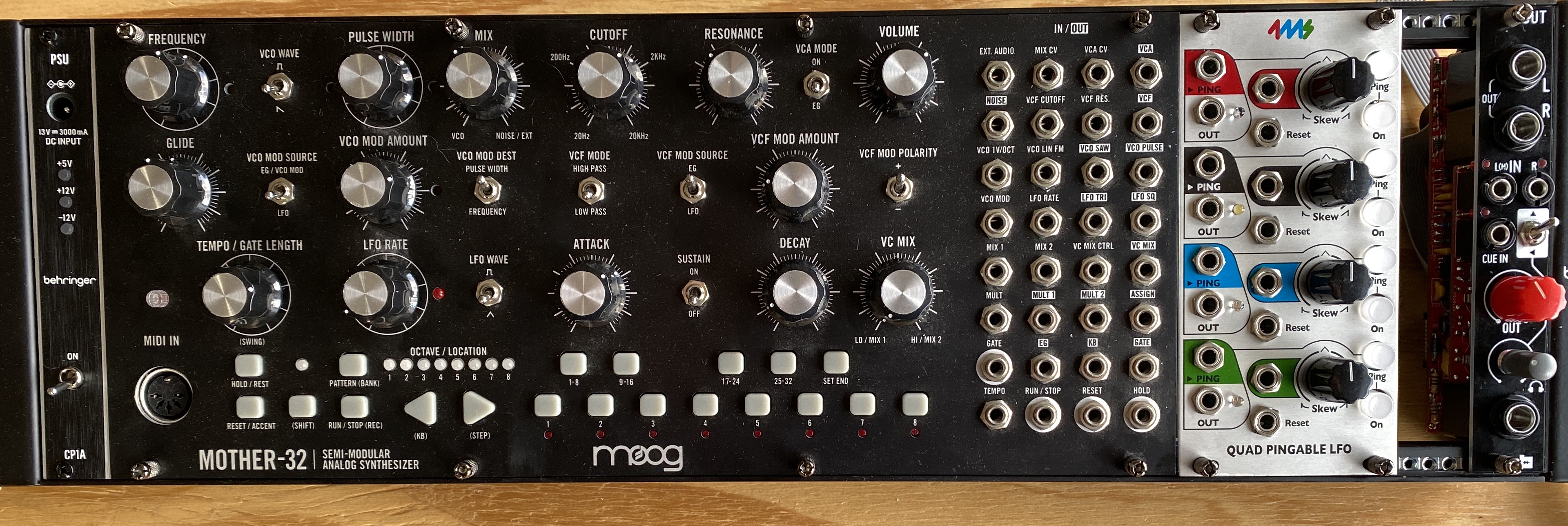
Someone asked off-line how I was going to finish out this rack module. Three more modules;
- the Quad LFO from 4MS, since Moogs love Mods
- A Befaco Out to feed my Focusrite Claret in the studio
- And one empty slot. I plan to put a powered Multi in there, but I don't have a spare right now, will fill it with a Patching Panda Copycat.
Leaves like a 1 HP gap but I can live with that.

Hi All! It's been a while since I posted any new recordings, but I have been busy recording stuff. This one I recorded early this morning after starting it on Sunday afternoon. It's my first experiment with the classic Todd Barton Krell patch. Huge thanks and acknowledgement to JD Cramer on ModWiggler for his most excellent recent tutorial series on this venerable modular patch and its methods and madness. Search YouTube for "The Krellberg Variations" to see them. I included a full detailed description in YouTube. Cheers!
Yes! Thank you very much for putting this together. I'll set this up to play this afternoon.
Thank you TumeniKnobs, I really appreciate that.
This is very cool! Love both the track and the video. Excellent work! Thanks for sharing.
Well... there are patch cables and there are patch cables ;-) But too avoid a (very) long discussion... I will just share some experience I made with patch cables here.
I have just recently made some very bad experience with Endorphin.es patch cables, far too thin, not nice to use and the slipped out of my patch cable holders from Voltcraft ML-1 SW 14 "Messleitungshalter" (German for lab cable holder, freely translated). Not only the cable were very thin but also the plugs. I don't understand why Endorphin.es (who has in my opinion to keep up a good name in the market) wants to offer such a poor type of patch cables...
Anyway, I also less recently but after I posted here above my recommendation about Cordial CPI series, made some very good experience with Vermona patch cables. I think they are even a notch or two better than Cordial CPI series and roughly about in the same price category. The prices of these top-notch cables is quite an issue hence why I buy small patch cables from Make Noise. For that kind of money great patch cables (not top-notch though) and wouldn't cost you an arm or a leg and for the longer patch cables I still make them myself.
Regarding stackables, I actually never owned them myself, however seen and used them at my local dealer and from the above comments here I straight away knew that's not the road to go. External splitter might be an idea however why not just get a bunch of buffered multiples and all problems are solved? ;-) At my signature you will find my website where you can download for free PDF formatted review reports. All the multiples I have, I have reviewed them and published a review report of those. I am in the middle of all testing them in the same way so a more fair way of comparing them to each other will be established. By March/April I hope to have updated all the multiple review reports (those with Appendix A v1.26 or later are the updated ones and the ACL one is one of the new style measured multiples too). In Appendix A (separately downloadable at the "Other documents" tab) you can find in subparagraph 2.5.2.4 The multiple functionality in details how I have tested it.
Happy patching to everyone and kind regards, Garfield.
-- GarfieldModular
Many cheap buffered multiples introduce slight offset into signal. Not very important but if switched with some kind of sequential switch may make pitch jump half a not up or down. But yeah if you need more than on or two copies of signal passive splitters are better than stackables.
I have stackables. But I don't know about buying more of them. ... stacking them creates longer and longer levers...>
-- Ronin1973
Yes my concern too.
Other than that the sockets start to fail after some use.-- wiggler55550
You never need to plug more than 2 cables into one socket, you can just daisy chain them. But yes sockets usually fail after 2-3 years of frequent patching
I received my copy some days ago and had time to dive in a bit.
I'm a trumpet player and I can say that the hardware rocks. It's absolutely self-sufficient. No need of preamp-prefiltering. Be aware that with non-monophonic instrument like guitars, you have to play very clean to avoid any surprise. But with monophonic instrument and voice, it works really great. The firmware still needs a lot of work, but it's very promising.
Yeah. Fiiking brilliante. Instant fan base. Hoo!
Chomp chomp, chomp, more hunger. Yow. Me.
KALAMITY MOOFUH!!!
Mr. Kane
-- Herkjk
Thanks mate! Just took a few weeks off moving everything to a Doepfer Monster + Base. Back at it in between day job and minecraft with the kids.
No, I'll let someone else point out the obvious here...I'm tired of having to repeat the same goddamn thing over and over.
-- Lugia
But you did feel compelled to post a content free reply. I celebrate your enthusiasm.
--ck
... and I certainly plan to get lost in that buchla fog! I was in the middle of trying to make a drum machine out of my neutron with some random gates coming from the rampage comparator when the modules arrived. So nice to realize I didn't have to undo the rampage and use it for envelopes because I now have 4 buchla function generators to work with. I look forward to chaining/modulating the function generators together since I now have so many. The dual oscillator also offers many possibilities, fm/double fm, waveshape modulation etc. It has got to be one of the best value for money oscillators out there right now!? Still not exactly sure what the processing input and cv does? I get the inversion part but not the rest. When in doubt, use it and cv it and see what happens.
Just picked up a TakTakTak Drumbo Syncussion "clone" and made this quick demo as there are only a few videos online.
re serge: you can always buy them from random*source in modules - one at a time - some are available DIY too - but might not be for long - otherwise there's Elby in Australia that do serge like stuff iirc!
when I see building blocks I mainly think basic functions - lfos, vcos, filters, delays and a shed load of utility modules - something that you can use to 'patch anything up with' if you know what I mean...
"some of the best base-level info to remember can be found in Jim's sigfile" @Lugia
Utility modules are the dull polish that makes the shiny modules actually shine!!!
sound sources < sound modifiers < modulation sources < utilities

It'll be somewhere spacy, that's for damn sure!
I know for a fact that there's a PILE of the old-skool Detroiters that are outright salivating over the new "t" series. But then, that makes perfect sense when you realize that one of the tracks that early DJs in tha D were mixing was the rhythmic part of Part 2 from "Silver Apples of the Moon". Works like a charm!
Here's an idea...if you put in a module like the Strymon AA.1 or some other stompbox "integrator", once you're outside of the synth, there are some other possibilities for processing that aren't generally found in synth modules. The specific example I'm thinking of is E-H's TriParallel Mixer, which is crazy-versatile when you set up the attached stompers so that they ALL work like the same processor, albeit with some really trippy routing possibilities. I've used mine with some of the (in)famous Chinese stompboxes, and the results have been STELLAR. But that's one possible example; my studio itself also has its own parallelling system that uses a Studio Technologies Model 80 for distribution and buffering across eight stereo pairs, with a Rane SM 26B for summing on the "out" side of it. Instead of stompers, though, that system is for my 100+ rack processing units so that I can set up processing "cascades" with a lot less hassle than other methods.
yeah, yeah, I bought already a lottery ticket but so far nothing...
For review reports of Eurorack modules, please refer to https://garfieldmodular.net/ for PDF formatted downloads
Oh right! That's a good point... hmm... looks like we all have to buy some of that Buchla stuff, then we all go far down the Buchla Hole and perhaps we meet again in deep space
For review reports of Eurorack modules, please refer to https://garfieldmodular.net/ for PDF formatted downloads
Or, another possibility is that the OP's simply looking at the wrong synth format. What he's describing after clarification sounds a lot more like what you'd find in a Serge format system. Granted, Serge IS more expensive...but the over-the-top flexibility of the system is a part of that. And when you start breaking down the full and half-panels into per-module numbers, the cost isn't really all that horrible...you just have to get past the fiscal stumbling blocks of buying the panel sets.
@FatBerg: Oh yes!
And after weeks or months when you emotionally cooled down a bit, please share with us your experiences ;-)
-- GarfieldModular
You realize, of course, that he's now very far down the Buchla Hole...we might never hear from him again!
I've found that there are LOADS of possible cheap ways to manage patchcable piles. A trip to a home improvement store like Lowe's or Menards offers TONS of potential hooks, implements, and other hanger gibberish that works like a charm. Right now, I've got about 100+ 1/4" cables on these snazzy, rustic iron closethooks from Menards, and in a previous setup of the studio, I had my 3.5mms all on those cheap swinging kitchen towel-holders. And since both of these mount easily onto the MDF racks I use, I can stick 'em wherever they work best.
At least, this worked fine until I started building the AE system, which uses pinwires (along with some Bastl devices and a Folktek Mescaline). So, since I was setting up a section of commercial gridwall with shelves for the stompbox "library", I put one of those angled clotheshangers with the little balls on them onto the backside of the gridwall, under the table that holds the "sandbox", which puts the pinwires right where I need 'em!
Uhhhhh...
No, I'll let someone else point out the obvious here...I'm tired of having to repeat the same goddamn thing over and over.
Think of an oscillator with 4 simultaneous waveform outputs. Connect all four audio outputs into a VCA module that can mix like an Intellijel quad VCA. Then connect four modulation sources into the CV inputs... maybe a quad LFO like the Xaoc Batumi and set the Batumi to really slow rates. Of course you don't have to mix just one oscillator... or you could mix between effects or even mix CV sources instead of audio.
-- Ronin1973
This is what I usually call "strumming"...like running a pick across strings, but in this case it's modulation signals across multiple VCAs channeling different timbres. It's really an incredible sound, particularly if you pay close attention to the overlap between VCA levels and get a result that sounds like a smooth timbral transition. It's why I can't wait to get my mitts on one of those Buchla 281t reissues, as they have a quadrature capability that's perfect for that trick.
@FatBerg: Oh yes!
And after weeks or months when you emotionally cooled down a bit, please share with us your experiences ;-)
Enjoy and kind regards, Garfield.
For review reports of Eurorack modules, please refer to https://garfieldmodular.net/ for PDF formatted downloads
Hi Rama1065,
If you consider the "building block" concept idea then please have a look at a picture I made a while ago and I shared before:

How big each "building block" would/could be, I leave that up to you, for example each at 84 HP. In such example if you would have a monster case then one row of 168 HP could consist of two building blocks. Naturally a few blocks can be merged together to save space too.
Hopefully this will help and kind regards, Garfield.
Edit: I forgot to mention this below link here in the forum, it's discussing this similar topic, perhaps interesting for you?
https://www.modulargrid.net/e/forum/posts/index/9489
For review reports of Eurorack modules, please refer to https://garfieldmodular.net/ for PDF formatted downloads
Well... there are patch cables and there are patch cables ;-) But too avoid a (very) long discussion... I will just share some experience I made with patch cables here.
I have just recently made some very bad experience with Endorphin.es patch cables, far too thin, not nice to use and the slipped out of my patch cable holders from Voltcraft ML-1 SW 14 "Messleitungshalter" (German for lab cable holder, freely translated). Not only the cable were very thin but also the plugs. I don't understand why Endorphin.es (who has in my opinion to keep up a good name in the market) wants to offer such a poor type of patch cables...
Anyway, I also less recently but after I posted here above my recommendation about Cordial CPI series, made some very good experience with Vermona patch cables. I think they are even a notch or two better than Cordial CPI series and roughly about in the same price category. The prices of these top-notch cables is quite an issue hence why I buy small patch cables from Make Noise. For that kind of money great patch cables (not top-notch though) and wouldn't cost you an arm or a leg and for the longer patch cables I still make them myself.
Regarding stackables, I actually never owned them myself, however seen and used them at my local dealer and from the above comments here I straight away knew that's not the road to go. External splitter might be an idea however why not just get a bunch of buffered multiples and all problems are solved? ;-) At my signature you will find my website where you can download for free PDF formatted review reports. All the multiples I have, I have reviewed them and published a review report of those. I am in the middle of all testing them in the same way so a more fair way of comparing them to each other will be established. By March/April I hope to have updated all the multiple review reports (those with Appendix A v1.26 or later are the updated ones and the ACL one is one of the new style measured multiples too). In Appendix A (separately downloadable at the "Other documents" tab) you can find in subparagraph 2.5.2.4 The multiple functionality in details how I have tested it.
Happy patching to everyone and kind regards, Garfield.
For review reports of Eurorack modules, please refer to https://garfieldmodular.net/ for PDF formatted downloads
Very quick followup to my Behringer eurorack rack overview video.
Putting my Mother 32 in this unit. Very simple, very straightforward, but figured I'd post it just for completeness. A
Hi Sislte,
That's long ago that we have heard from you, it's more than a year ago, isn't it? I am so glad that you are back! :-) I missed your creativity and your style of music.
This track makes it so much worth the more than one year waiting for it! :-) I hope you don't let us wait so long again and hopefully I am able to listen at your very interesting and creative tracks more often?!
Kind regards, Garfield.
For review reports of Eurorack modules, please refer to https://garfieldmodular.net/ for PDF formatted downloads
I have stackables. But I don't know about buying more of them. ... stacking them creates longer and longer levers...>
-- Ronin1973
Yes my concern too.
Other than that the sockets start to fail after some use.
I have stackables. But I don't know about buying more of them. The issue I have with them is that stacking them creates longer and longer levers inserted into your modules. It becomes easier and easier to accidentally bump those stacks with your hands. Depending on the module you could do some damage to the jack or circuit board below. I would use Y cables for anything that's directly inserted into a module or using an outboard passive splitter like those made by Intellijel.
I think one possibility not discussed is mixing.
Think of an oscillator with 4 simultaneous waveform outputs. Connect all four audio outputs into a VCA module that can mix like an Intellijel quad VCA. Then connect four modulation sources into the CV inputs... maybe a quad LFO like the Xaoc Batumi and set the Batumi to really slow rates. Of course you don't have to mix just one oscillator... or you could mix between effects or even mix CV sources instead of audio.
If you combine mixing with filter modulation, etc. the sky is the limit.
Will get that fixed @JimHowell1970.
-- troux
& well done everyone - not listened to everything all the way through yet - will do soon!!!
"some of the best base-level info to remember can be found in Jim's sigfile" @Lugia
Utility modules are the dull polish that makes the shiny modules actually shine!!!
sound sources < sound modifiers < modulation sources < utilities
yes you can you'd just need to have all sequenced notes starting above the threshold on the comparator and gaps between all sequenced notes with voltages below the threshold - it's a workaround and may not be optimal - but it would work
-- JimHowell1970
Throw in an offset and I think you'd be fine with the comparator. Example: Befaco Dual Attenuverter.
-- Ronin1973
I'm not convinced - but it might be possible - how would you patch it?
"some of the best base-level info to remember can be found in Jim's sigfile" @Lugia
Utility modules are the dull polish that makes the shiny modules actually shine!!!
sound sources < sound modifiers < modulation sources < utilities
yes you can you'd just need to have all sequenced notes starting above the threshold on the comparator and gaps between all sequenced notes with voltages below the threshold - it's a workaround and may not be optimal - but it would work
-- JimHowell1970
Throw in an offset and I think you'd be fine with the comparator. Example: Befaco Dual Attenuverter.
I have read some comparator manuals and I do not think that the output from my sequencer can be used for creating trigger pulses, but I can be wrong.
With the linked picture I try to explain.
https://tinyurl.com/v8sz54g
Fig. 1 shows the output from my sequencer and fig.2 shows how I think the output must look like for creating comparator triggers.
-- Rookie
yes you can you'd just need to have all sequenced notes starting above the threshold on the comparator and gaps between all sequenced notes with voltages below the threshold - it's a workaround and may not be optimal - but it would work
"some of the best base-level info to remember can be found in Jim's sigfile" @Lugia
Utility modules are the dull polish that makes the shiny modules actually shine!!!
sound sources < sound modifiers < modulation sources < utilities
Thanks Jim!
-- GarfieldModular
"some of the best base-level info to remember can be found in Jim's sigfile" @Lugia
Utility modules are the dull polish that makes the shiny modules actually shine!!!
sound sources < sound modifiers < modulation sources < utilities
I'm looking for possible building blocks, which provides useful functions for larger racks.
VCOs, filters, effects and so on may be placed around these building blocks ...I'm on the way to make a bigger studio eurorack, not for life performance.
-- rama1065
then start with a much bigger rack and try to think along the lines set out in my signature
I don't see a lot of what I would call basic building blocks of modular synthesis in the above racks
I see more 'synthesis with modules' as opposed to 'modular synthesis'
"some of the best base-level info to remember can be found in Jim's sigfile" @Lugia
Utility modules are the dull polish that makes the shiny modules actually shine!!!
sound sources < sound modifiers < modulation sources < utilities
just to qualify the above (slightly)
I started of in modular because about 7 years ago* I was staring at my moogerfoogers and cp251 and realised that they were effectively part of a modular synthesizer - so I started researching modular synthesizers - about 2 years later I started building one
*this was over 30 years after first picking up a guitar and 20 years since I got into synthesizers/music production - although there have been a few gaps due to life!
"some of the best base-level info to remember can be found in Jim's sigfile" @Lugia
Utility modules are the dull polish that makes the shiny modules actually shine!!!
sound sources < sound modifiers < modulation sources < utilities
Hi toodee,
thanks for you input.
Yes, perhaps the question is too generic, I understand.I'm on the way to make a bigger studio eurorack, not for life performance.
Thanks!btw. yes, satelitte can be used stand alone. But you need a control forge in order to create own modulations.
-- rama1065
Cool, sounds like an interesting project :-)
And then by all means, do follow the advice given by our friendly Lugia and post the current state of your project to a new thread and get specific advice for your needs, making clear what you already have and how you use it, as well as what you hope to achieve moving forward. Then you can use that advice for more focused research, keeping in mind that it's almost always better to think in terms of function rather than specific modules IMHO.
Looking forward to read that future discussion (and learn from it, of course) !
Take care,
D
--- Voltage control all the things ---
firstly I would go for a bigger case - it may save you buying a second case and therefore money in the mid-long term... the best bang for buck starter cases are either tiptop mantis or doepfer lc9 - if you are intending on more digital modules then I would recommend the mantis more (and it is more portable, if that's an issue) - however both are probably the best combinations of hp/cost/good power supplies from respectable manufacturers available
otherwise it's kind of an ok start, depending on what instruments you are thinking of processing...
if all you really want is some filtering and granular processing - I would seriously consider (ie spend a month or 2 thinking about it) whether you really want to go modular or whether a few effects pedals will suit you better - they will almost definitely be a less expensive solution
your starting idea of an input module with envelope follower and a sound processor is good (but see below)
if your sound sources are stereo then a second ears or similar module (pre-amp with envelope follower built in) is a good idea - mostly so that you can extract the envelope shape of both the L & R channels for use in modulation, rather than just one
if your sound source is mono, for example a guitar, then I would strongly advise the addition of an expression pedal interface (examples are available from ADDAC, Doepfer and 7 dials) to enable you to play the guitar (for example) and still control your effects - in fact you may want more of these - otherwise you would probably be better off with more effects pedals - a wah pedal instead of the filter and I'm sure there are granular synthesizers in pedal form these days
as for your module choice:
ears - owners seem to like it so it appears to be a good choice although I've never used one - I have a doepfer a-119 instrument interface module - which adds a comparator (a gate opens when the input signal excedes a set voltage) and adds grit, shall we say - and is slightly cheaper - there is also a chip swap (no soldering required) that can be done to reduce the grit but I have never felt the need - furthermore the gate output can be extremely useful as a replacement for or alongside a master clock - nb a lot of modules need steady clocks to operate properly - Pams doesn't work well for example, nor any modules that multiply clocks - dividers and modules that provide triggered lfos or envelopes tend to work much better
maths - great module - although I always recommend both downloading the 'maths illustrated supplement' and working your way through it AND replicating it's basic functionality in dedicated modules - maths is much greater than the sum of it's parts - and you will need those parts separately as well to allow you to use maths to it's full potential (which points us back to the illustrated supplement)
humpback - this is a DIY module - I don't know if you can buy built ones, I've never seen them - are you skilled and do you have the tools to build it? if not I would consider an already built filter - doepfer make a great selection of reasonably priced ones - based mainly on classic designs - or there are many more available at differing price points - if however, you intend to buy a soldering iron and build this - I would also suggest building some simpler modules to start with - a passive mult, an attenuator (thonk atatat) and some of the AI Synthesis range would make the learning curve easier and less frustrating for you - again you may find you want 2 filters or a stereo filter instead of this
clouds - are you intending on trying to find one used? or a clone? it has been discontinued for a few years and has been replaced in the mutable line up with beads - I would spend some time considering this - read reviews/watch youtube videos of beads etc - mutable support is fantastic, but understandably stops at 3rd party clones - most of which push it into poor ergonomics territory (eurrorack is already very small without miniaturization of modules) - supercell is a larger cloen with a few extra additions and may be worth a look
the vca - ok but personally I would replace it with a veils - it will initially work as a mixer too, but I think that you'll want more mixing - and particularly something that can handle stereo output (see erde-verbe section below)
erde verbe - great reverb for emulating 'weird spaces', but not a particularly good general purpose reverb - takes a mono signal and outputs a stereo signal - you may really want a stereo to stereo (to add more reverb to clouds) or a mono reverb (depending on the requirements of your output - stereo/mono)
Pams - hmm - not really a function generator as you described it - it's more of a master clock, clock divider/multiplier with some synced envelope generation/lfos - whereas function generators generally apply mathematical functions, such as slew to incoming signals and extract events from these signals - so in some ways similar to a function generator, but not really - note it's heavily synced to it's clock (internal or external) which may not suit you depending on how you intend to use the rack and how accurate your timing is with your instrument - I'm human and so a bit sloppy at the best of times - which can be both a good thing and a bad thing, depending on your point of view and what you are trying to do!
further effects processing modules - more filters - and I would look seriously at the happy nerding fx aid xl - very versatile - I would make this an early purchase as it can be used as a filter - as well as reverb, delay, lofi etc - if I was designing an effects processing rack I'd probably include 3 of these due to their versatility
utilities - you'll almost definitely want more utilities - seemingly dull inexpensive modules that appear to do nothing to alter the sound (they are the dull inexpensive polish that makes the expensive shiny modules actually shine) - they are incredibly useful for not only improving the patching possibilities - but also for solving problems - like (auto-) panning a mono signal into a stereo space, or switching between multiple inputs into a single output or vice versa, or reducing the amount of modulation that is sent to an input (especially useful with clouds - it's modulation inputs really need attenuators! I usually recommend a great utilitiy starter set of mutable links, kinks, shades and veils - or modules that cover their various functionalities - wmd/ssf toolbox and happy nerding 3*mia make good substitutes for some of these funcionalities
mixing - seriously consider how you will mix mono & stereo audio signals together and which modules have mono/stereo inputs and mono/stereo outputs - and the possibility of parallel processing - you will almost definitely need multiple mixers - some for sub mixing, one for end of chain mixing and some for mixing modulation sources - some of which should be voltage controlled - and this is on top of what you already have in the rack - I'd definitely recommend a matrix mixer - both for mixing modulation sources and for
moogerfooger - luckily these are some pedals that really don't need an effects pedal interface to reduce the signal down to guitar level and bring it back up to modular level and correct any impedance issues - I have 3 of them and have used them quite a lot with my modular - a lot of other pedals really need the interface to work properly
"some of the best base-level info to remember can be found in Jim's sigfile" @Lugia
Utility modules are the dull polish that makes the shiny modules actually shine!!!
sound sources < sound modifiers < modulation sources < utilities