Maybe 2hp adsr but I heard they are really tight to control
The good thing about the 2hp line is that it's small, the bad thing about the 2hp line is that it's small. It's just not really nice to play around with because it's tiny pots on a small surface.
I think the ones that are a must are Vhikk X and Black Sequencer which are 66hp
Okay, so you have 22hp to spare.
Reverb
The original Happy Nerding FX AID is 4hp and I'm pretty sure it's based on the same chip (Spin chip) as the Timiszoara. It will not sound exactly the same, but I think it will be recognisable if you like the Timi. Pico DSP by Erica Synths is 3hp and likely the same.
Filter
100 Grit and Angle Grinder by Schlappi Engineering are amazing. Angle Grinder is my favourite Eurorack module. It's based on feedback/waveshaping distortion though, it doesn't sound like a fuzz pedal would for example. But they don't suit your size requirements. If you have just one filter in your system, I think it should be a multimode filter. Just a lowpass will not cut it, in my eyes.
A-124 SE Doepfer 'the wasp' 8hp bit weird but aggressive
LE BRASIER Sovage Engineering 10hp definitely aggressive
Cinnamon Bastl Instruments 5hp small, aggressive
uJove Plum Audio 8hp Roland style, 'fat'
Black Multimode VCF Erica Synths 10hp allround good
With distortion
Eddy by Schlappi Engineering is a triple stereo VCA/mixer with distortion in 8hp
I tried Terci Ruina by Noise Engineering, but I did personally not like it. It's distortion in only 4hp though
Envelopes
If you need only one (I think you need more than one) VC ADSR by Befaco 8hp
Zadar by XAOC has 4 envelopes in 10hp
I wouldn't mind something like FX AID, Cinnamon, Eddy and Zadar. That's 27hp.
Or FX AID, LE BRASIER and Zadar. Mix with an external mixer. That's 24hp.
FX AID, Cinnamon, Eddy and 2 2hp ADSR is just 21hp if you really want to keep within 22hp.
If I'm couting correctly, the modules you absolutely want to keep amount to 111 HP. It seems to be a reality that the 88 HP case you have will not be enough.
There are smaller dual envelopes and smaller dual multimode filters than you have currently, but you're shaving off maybe 10 HP at most.
-- stefvanriet
I think the ones that are a must are Vhikk X and Black Sequencer which are 66hp. Timiszoara is great but I could swap it for a smaller reverb, I use it mostly just to fill audio space. I could maybe substitute the envelope generator with Black Seq adsr but it would be nicer to have a dedicated knob... So I am looking for a filter with distortion, and a clear reverb. Maybe 2hp adsr but I heard they are really tight to control.
Hi FLAMANT, have you looked at other 'first rack' posts on this forum? I think it will give a lot of inspiration regarding modulation, envelopes, mixers and effects. There's some fan favourites that will show up again and again. Once you're ready, post a link to your rack.
Which one or two would you build around or you would choose something else
Taking into account your desire for dark textures and atmoshperes, my personal choice would be the Befaco Oneiroi. VHIKK X also fits the bill. Verbos Sawtooth Stack seems limited in versatility and is the most expensive. OXI Coral doesn't lean into what you want to achieve.
If I'm couting correctly, the modules you absolutely want to keep amount to 111 HP. It seems to be a reality that the 88 HP case you have will not be enough.
There are smaller dual envelopes and smaller dual multimode filters than you have currently, but you're shaving off maybe 10 HP at most.
I second this. The amount of envelopes is large, remove Tangrams and add Dixie II if you want to keep it all Intellijel?
Metropolix is quite extensive for this compact system. I would downgrade to something like Varigate 4+ by Malekko Heavy Industry and use the new space for something else. LFO/S&H or a distortion or anything you like.
So I wanted to have Vhikk X as a synth voice as a companion to my Elektron hard/industrial techno dawless setup. Quickly things got out of hands, and I think this system is a bit oversized now. The Black Seq is here to stay, as well as Timiszoara. Swords also sounds great but is a bit large. I'm not even sure why I got the MIX BX but it sounds absolutely fantastic... Baths is just doing envelopes for Vhikk X VCA and Swords filter cutoff. I don't actually own the 100 Grit or the joystick/buttons but kind of want them. Anyway enough rambling, I'm looking for help if someone has any idea how to compact this system down. I have a 88hp case around, would be ideal if I could streamline and compact this setup into that one.
I’m putting together my first Eurorack for live sets in an 104 HP case. I’ll use my Digitakt II for drums (and bass maybe) and sequencing and my Neuzeit DROP for hands on control.
I want to build around dub techno while keeping the rack flexible enough to explore other genres. I’m into dark textures and atmoshpheres and overall darker sound. I’d also like to try some self generating patches with or without the Digitakt.
I like the Verbos Sawtooth Stack, OXI Coral and VHIKK X. Which one or two would you build around or you would choose something else. How would you use the remaining space for modulation, effects and mixing?
I’m feeling a bit overwhelmed by all the module options so I’d really appreciate any advice.
I was just trying to respond to a message I received from another member. When sending my message I got the error "Recipient is not a full member. The requested address was not found on this server.".
It seems that either this is a bug and the address should be there, or this is expected behavior in which case the member probably shouldn't have been able to send me a message either :)
I have a question about an issue with a Sealegs module I purchased second-hand. I am experiencing the following:
With the Mix set to fully dry:
Left In (Mono): No audio seems to enter the module.

Right In: A mono signal passes through.

Left Out (Mono): No audio comes out.

Right Out: Audio comes out, but I only hear it from my left speaker.

Stereo input and stereo output: I only hear audio from my left speaker.
When I turn up the Mix, I can hear the delay and reverb through both speakers. However, the dry signal from the external source is still only audible through the left speaker.
I also feel that the delay output is very low, although this might be related to the input signal only passing through one channel.
Is this a known issue, or have you encountered something similar before? Is there anything I can check to identify the cause?
The seller claims that everything was working normally when they shipped the module.
Thank you for your help.
NoSky
PS: I sent this one to one to the intellijel support. But maybe someone of you can say something to this issue?
I had a look at the Morph 4. It does seem like it could take over the whole crossfade in one module and the overlapping response sounds more musical than a straight dry against wet fade. One thing I wasnt sure about: Route 4 seems to switch rather than blend, so I think I’d still want it for distributing gates. But I may be misunderstanding what the Morph 4 actually does.
Depending on the width, controlled by 'span' on the Morph 4 module, you can use it to switch rather than blend. From 7:50 ->
Either way, I’m going to work through your points properly and then simply get the thing running first. It’s all built, but I haven’t patched a single cable yet, so I suspect a few weeks of actually using it will answer more questions than another module would.
thanks again, that’s really generous of you, especially for going back to the Maths manual.
The offset detail is a most useful thing I’ve taken from all this. Channel 2 at 5 V, channel 3 at 10 V and pulling channels 2 and 4 out of the SUM with a cable. I’d never have worked that out on my own, so it’s written down now...
Good to know about the mult too. I’d been worrying about something that apparently isn’t a problem.
I had a look at the Morph 4. It does seem like it could take over the whole crossfade in one module and the overlapping response sounds more musical than a straight dry against wet fade. One thing I wasnt sure about: Route 4 seems to switch rather than blend, so I think I’d still want it for distributing gates. But I may be misunderstanding what the Morph 4 actually does.
Either way, I’m going to work through your points properly and then simply get the thing running first. It’s all built, but I haven’t patched a single cable yet, so I suspect a few weeks of actually using it will answer more questions than another module would.
Thanks very much for taking the time, this has been genuinely helpful.
Sascha
On the crossfade: you mentioned that if the inverted envelope goes below 0 V, ... do the inversion and offset within Maths itself?
Looking at the manual of Maths again, channel 2 and 3 do add offset. I missed that yesterday. Channel 2 adds 5 volts, channel 3 adds 10 volts. The envelopes on channel 1 and 4 are 10 volts. So the S-shape is your positive output, and 1 (knob turned to negative) plus 3 (knob turned to positive) will be your offset negative output.
SUM output
SUM sums channel 1 to 4. So that does work, but only if you are removing channel 2 and 4 from the SUM, by plugging a cable in their outputs. At least it's nice to have the whole procedure in a single module.
The buffered mult point is interesting, I hadn't considered that at all. Does it make a difference that I'm splitting audio rather than CV? I was a little worried about losing level across three branches, but I genuinely don't know whether thats a real concern or just something I picked up somewhere.
CV or audio makes no difference. The level loss is redundant. Eurorack levels are already much higher than normal audio equipment. The manual of most/all(?) mults will say that it handles both audio and CV.
On the Transmit 2: sorry, I should have explained. The rest of my studio uses balanced connections and goes through a patchbay into an RME interface, so everything around the rack is already XLR and TRS. Would you still leave it out in that case? I'm not sure how much difference it makes in practice.
If this is important to you, then go for it. Since you have the module already, you can try it both ways and see if it makes a difference.
I wondered whether its role might be more about voltage-controlled modulation. For example, I could run an LFO through it and use Marbles to vary the modulation depth. Does that make sense, or am I just talking myself into keeping it?
That does make sense, the Quad VCA seems a bit full-featured for just that. I think A* B+C does that same trick. I noticed that it's only 130 € second-hand, that already makes it a better choice than I would've said at first glance. Just as an idea, you should have a look at Morph 4 by Joranalogue. It could potentially do what you intend to do with Route 4 and Quad VCA in one module.
Thank you so much for taking the time, that's really kind of you.
I should say up front that I'm very much at the beginning with all this, so some of what I ask may be basic.
On the crossfade: you mentioned that if the inverted envelope goes below 0 V, the VCA won't open and that I'd need an offset. Isn't that what the ABC would be doing? I thought setting B to −1 would invert the signal, and adding an offset with C would bring it back up, giving me 5 V down to 0 V rather than 0 to −5 V. But I'm not entirely sure I've understood that correctly.
I've also read that channels 2 and 3 on Maths have their inputs normalled to fixed voltages, so they can be used to generate offsets when nothing is patched in. Could I perhaps use that together with the SUM output to do the inversion and offset within Maths itself? I haven't tried it, I'm just wondering.
The buffered mult point is interesting, I hadn't considered that at all. Does it make a difference that I'm splitting audio rather than CV? I was a little worried about losing level across three branches, but I genuinely don't know whether thats a real concern or just something I picked up somewhere.
On the Transmit 2: sorry, I should have explained. The rest of my studio uses balanced connections and goes through a patchbay into an RME interface, so everything around the rack is already XLR and TRS. Would you still leave it out in that case? I'm not sure how much difference it makes in practice.
On the power, thank you, I'll make sure to leave some headroom.
And the Quad VCA question really got me thinking. You're right that the A-135-3 already covers the audio side. Afterwards I wondered whether its role might be more about voltage-controlled modulation. For example, I could run an LFO through it and use Marbles to vary the modulation depth. Does that make sense, or am I just talking myself into keeping it?
Would enough builders prefer to handle these tasks themselves to save money?
Personally, I buy DIY kits quite often - both to save some money and simply because I really enjoy the soldering and assembly process.
Here is my perspective as a builder:
Pre-assembled SMD is the sweet spot: I really dislike hand-soldering tiny SMD components. Having the mainboards fully populated and pre-tested by the PCB house, leaving only through-hole parts like jacks, pots, buttons, and display headers for the builder, is the ideal approach.
Full Kits over Partial Kits: Please offer complete kits with all mechanical parts, hardware, and hex nuts included. Searching through multiple webshops for specific hardware or jacks is a pain.
Option to Buy Fully Assembled: Even though I enjoy building kits, there are definitely times when I’m short on time or just prefer buying a fully assembled and tested module right out of the box.
Offering both options (Full DIY Kit with pre-assembled SMD vs. Fully Assembled Module) - much like Befaco does with their lineup - is definitely the best path forward in my opinion! Plus, if you notice down the road that the DIY kits aren't selling as well and people prefer fully assembled modules, you can always solder the remaining KITS yourself and sell them as completed units.
Since april I've been building a mostly analogue stand alone case for making improvised techno. I want to have everything I need in the case itself. I like exploring but mostly I am into minimal, psychedelic, hypnotic or dub techno. This is my second attempt at making a stand alone instrument. The middle strip is in reality a 80 mm strip of plywood which contains self made modules like 8 A/mute/B switches, 8 portal jacks to connect left and right far ends of the case, 8 1:3 passive mults, 2 passive low pass gates and 2 1:4 rotrary switches with mute. This week the Tesseract sequencer arrives and that makes the case almost full. I intend to play live techno on it. What do you think this is missing? What would seriously enhance my sonic and musical range? I do not like deep menu diving or digital moduls with screens all too much but feel free to try and change my mind. There is 10 HP still open and some modules can be removed eventually like the osciloscope.
The part I've been thinking about most is the crossfade. My plan is to use Maths to generate 0 to 5 V, distribute that with Link 2, and use the A*B+C to invert and offset one copy so it gives me 5 V minus X. The dry channel would get that inverted CV while the two wet channels get X. In theory, one voltage should fade the dry signal out as the processed signals come in. I haven't tested this yet, so I'm curious whether it makes sense or if there's a much simpler way of doing it.
I re-read this five times but it's hard for me to grasp what you want. I think you want to make an envelope with Maths and use that to boost one set of channels and mute the others and vice versa.
To do that, trigger/cycle channel 1 of Maths, take the output from the sort-of S shape OUT (Unity Signal Output in Maths manual). That one should be the positive output. Turn the knob of channel one at the top to the left, to the minus symbol. The OUT labeled 1 should give the negative output. When one goes up, the other goes down. Mult accordingly from there.
You can see that in this video at 4:40.
If the negative envelope is below 0V, the VCA will not open. In that case you need to offset so it's always opened, but closes when the envelope goes up. You'd have to check that for yourself, I don't own Maths so I can't check that.
The bottom row draws around 680 mA on +12 V, against the RackBrute's 800 mA per row limit. Is anyone running theirs that close to the limit without issues, or would you redistribute some modules?
I would definitely keep well within the specs provided. It's difficult to explain to your home insurance company what you were doing if something goes wrong.
If you're running low on volts, I think you can save some here:
* Buffered mults are useful for precise v/oct tracking, but since you want no oscillators, you could replace them with passive mults and save a bit of volts.
* If you make music just for your hobby and don't plan on professional recording or touring, you could do without the Transmit 2 and just go from the mixer to your interface. It helps to turn on pad on your interface to lower the signal some dB.
What would you put there, bearing in mind I don't want a VCO in the case?
It's kind of difficult, it seems like you mostly want an effects board and it seems to me like you have achieved that. A stereo filter is always great I guess.
I'm also wondering what ground the Quad VCA will be covering. The Doepfer mixer is also a VCA and it seems to me that that has all the sound sources covered. Maths and A* B+C has attenuation duties covered.
Is there a way to choose a preference of not automatically swapping modules when arranging/rearranging? It's so easy to slip or overlap. It becomes difficult sometimes to find where the swapped module ended up. I know there is a rack lock feature, but I would like to be able to arrange and manually swap when necessary, without locking it entirely.
Also, would you be able to split the difference when zooming in and out? I find that the sweet spot for my rack would be halfway between what is too big for my screen and what is too small. It makes pretty big jumps.
Thanks so much for all you do!! Your service is invaluable to the community!
I'm fairly new to modular, so be gentle. I've been putting this together over the last few months and I'm finally at the point where I can start patching it up. Before I do, I'd really like to hear what people think of the idea and whether there's anything obvious I've overlooked.
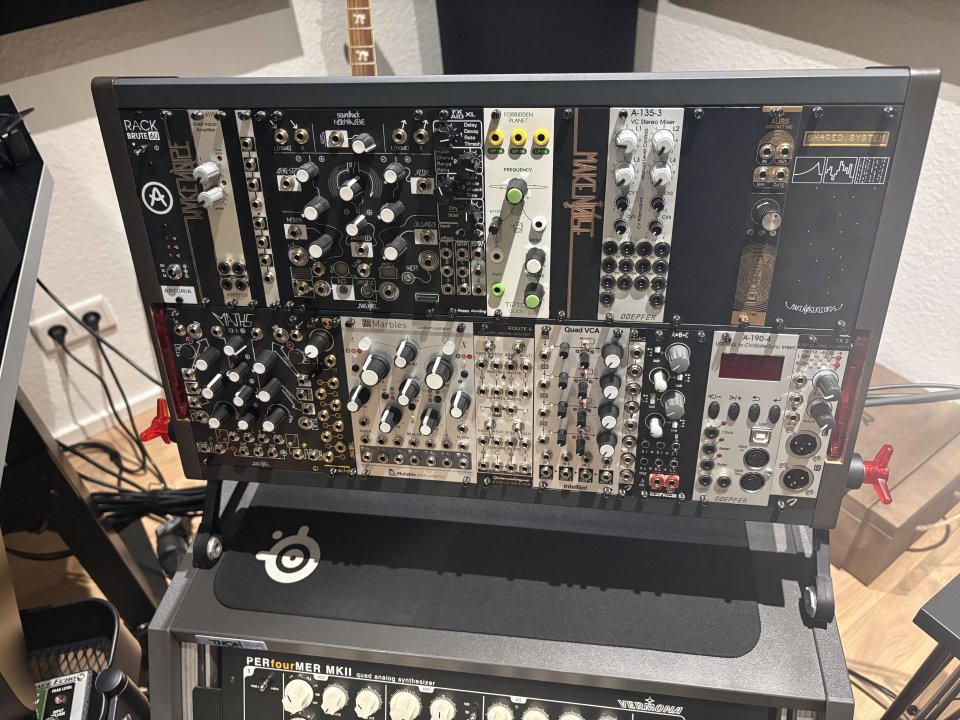
The thing that probably looks odd first: there's no oscillator or conventional synth voice in the case at all. That wasn't an accident. I already have a Vermona PERfourMER with four analogue voices sitting right under the rack, so I built the case as somewhere to mess with sound rather than make it. The PERfourMER will come in through the A-119-2, there's an Auris contact mic module for hitting and scraping things, and the Morphagene has its own samples on the card.
The idea is to split the incoming audio three ways using a buffered mult: dry, Morphagene and FX Aid XL. The three paths then come back together in the A-135-3, with the Transmit 2 taking the output straight into my interface.
The part I've been thinking about most is the crossfade. My plan is to use Maths to generate 0 to 5 V, distribute that with Link 2, and use the A*B+C to invert and offset one copy so it gives me 5 V minus X. The dry channel would get that inverted CV while the two wet channels get X. In theory, one voltage should fade the dry signal out as the processed signals come in. I haven't tested this yet, so I'm curious whether it makes sense or if there's a much simpler way of doing it.
Marbles and øchd are there for random modulation and slow movement. The A-190-4 on the right only went in this week. The idea is to use it to get clock from my Octatrack into the rack, with MIDI to CV and gate available as well. I figured I'd probably regret not having everything follow the same tempo.
It isn't finished. The blank panels are on purpose. I'd rather work out what's genuinely missing than fill the case up guessing.
What I make is minimal and micro house with long slow pads, Smallville kind of territory. The Forbidden Planet is new as well. I got it because everything else I own sounds round and warm and I wanted something that doesn't.
So, three things I'd really like to know:
Does the A*B+C crossfade idea make sense, or am I overlooking something obvious?
There's about 29 HP free in the top row. What would you put there, bearing in mind I don't want a VCO in the case?
The bottom row draws around 680 mA on +12 V, against the RackBrute's 800 mA per row limit. Is anyone running theirs that close to the limit without issues, or would you redistribute some modules?
I'm just about ready to start experimenting with it, so any thoughts before I dive in would be much appreciated.
Thanks for reading, and have a nice evening.
Sascha!
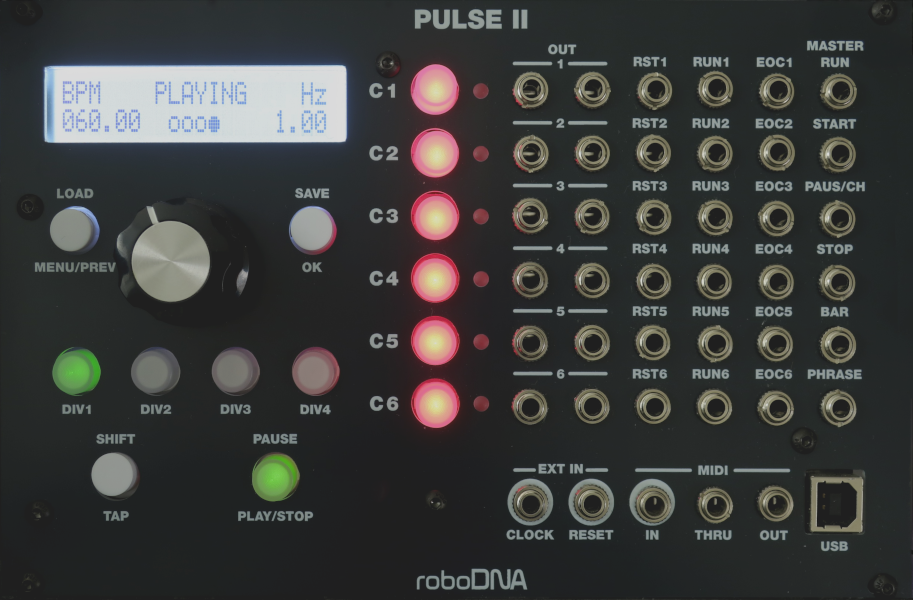
I'm in the process of calculating manufacturing costs for roboDNA Pulse II ( https://roboDNA.com ). It has a total of 3 PCBs ( 4 including the roboDNA LCD Display carrier board ).
The 2 main boards are mostly smt components and come fully spun from the PCB house. They do the initial logic testing for the core components. I've also automated most of the secondary testing with custom test fixtures to run in-house...
By connecting the Pulse II to a fixture, I can run Linux-based diagnostics that generate the dump/performance graphs as seen in the user guide.
I also built the "roboDNA Pulse Monitor" module into the Pulse II module so it can be used for longer-term endurance testing over days or weeks (which beat dealing with a logic analyzer's billions of samples).
The main sticking point is the 'easier' parts of the manfuacturing process are the most time consuming by far so the most expensive; tasks like through-hole soldering jacks, buttons, lcd display carrier board, hand-threading hex nuts onto jacks and ensuring it all aligns with the faceplate.
Because of this, I'm considering offering a Pulse II Builder Kit (pre-assembled SMT mainboards, you just solder the mechanical components and assemble the hardware) to keep the final cost down without cutting corners on quality.
Would enough builders prefer to handle these tasks themselves to save money?
Personally, I prefer soldering my own jacks/buttons myself to make sure they are nice and solid since they take the most cable patch wear-tear.
I suggest watching the Youtube video by Loopop (25 minutes) on Maths and the video on ARC (50 minutes) by Divkid for a better understanding of both.
-- stefvanriet
I watched loopop's video on maths and plan to watch it again once abacus arrives so i can actually use it and come to grips with it. i'll check out the divkid ARC video, thanks!
An envelope follower on that input would be useful.
Me with the Doepfer again...
The A-119v has a robust pre-amp with balanced and unbalanced inputs,
a nice big 1/4" feed me! input and a mini one too.
You can send it almost anything and it'll pull it out or calm it down.
The envelope follower is really fast, and gives a threshold gate out too.
Hundred bucks, takes 8hp. Does the job really well.
-- noodle_hut
i looked into that one as well. the quarter inch jack is tempting, but the module is mono and i'm not sure i'll make use of its envelope follower features, although it does sound fun. i plan to record my digital piano in stereo into my eurorack, so i went with the pico input (and a dual quarter TS cable to TRS!)
An envelope follower on that input would be useful.
Me with the Doepfer again...
The A-119v has a robust pre-amp with balanced and unbalanced inputs,
a nice big 1/4" feed me! input and a mini one too.
You can send it almost anything and it'll pull it out or calm it down.
The envelope follower is really fast, and gives a threshold gate out too.
Hundred bucks, takes 8hp. Does the job really well.
An experiment with OAM's "Time Machine" multi-tap delay and its new VCA expander, to see how much melodic and rhythmic variety it can generate from a simple 5-note sequence.
Detailed patch notes included.
I guess I just immediately clocked that there are no channels 2 and 3 on the ARC, but it seems 2 and 3 mostly serve as attenuverters? idk. it is also 4HP more than the maths!
I suggest watching the Youtube video by Loopop (25 minutes) on Maths and the video on ARC (50 minutes) by Divkid for a better understanding of both.
do you think erika synths pico input would also work well for me?
For a rack like this, it is common to add something like Mutable Instruments Ears or Mikrophonie right at the front. It boosts the signal to Eurorack levels. It's essentially your output module, but in reverse. Things like filters and distortions react differently to different gain levels. Both of these are not in stereo though.
do you think erika synths pico input would also work well for me? just getting an external mono or stereo signal into modular level? i'll likely record an external synth or piano straight into my nebulae
what could be the reason for this to come into existence?
This is the most weird and obscure module I have seen posted here in my few years on the Eurorack rabbit hole.
The A-121sV filter is very nice, delicate and subtle, but an expensive choice.
If you don't need the LFO square waves, the Doepfer A-147-5 Quad VCLFO
gives you more variety with external and group control of the four LFO frequencies.
Stacking cables are awful. Unpredictable impedence ghosts.
They're clunky and apply torque to the jacks and can break them. Don't.
What might be useful instead is the Frap Tools 333 ProAudio Sum & Distribution.
It's 6hp, a hundred bucks. Great for adding, mixing, and sharing CVs, triggers, or audio, times 3.
It can even be a 1:9 buffered multiple.
Pristine, transparent, and with 6dB(50%) attenuators. I'd get two. Mix and share the love.
In what way? Focusing just on the ARC now, it's really similar to Maths, both are Buchla/Serge style envelope generators. On the downside, ARC doesn't have the two passive attenuverter channels that Maths has in the middle (channel 2 and 3). But in return, ARC has logarithmic to exponential control on both rise and fall right on the panel, one more logic (X>Y) and End of Rise and End of Fall on both channels, instead of just End of Rise on Maths on the left channel and just End of Cycle on the right. You already have the Befaco Atte for attenuvertion, so the ARC sounds better to me for a lower price.
I guess I just immediately clocked that there are no channels 2 and 3 on the ARC, but it seems 2 and 3 mostly serve as attenuverters? idk. it is also 4HP more than the maths!
when I post a link it's to an old WIP I had that isn't updating
Oh I'm not sure why that would be.
bought a stereo filter
I think that makes a lot of sense. And they work as dual mono as well. As you may know, resonant filters on full resonance are sinewave oscillators. FM one into the other, or both into eachother, and you'll find a lot of crazy sounds there too.
they don't seem as versatile as Maths?
In what way? Focusing just on the ARC now, it's really similar to Maths, both are Buchla/Serge style envelope generators. On the downside, ARC doesn't have the two passive attenuverter channels that Maths has in the middle (channel 2 and 3). But in return, ARC has logarithmic to exponential control on both rise and fall right on the panel, one more logic (X>Y) and End of Rise and End of Fall on both channels, instead of just End of Rise on Maths on the left channel and just End of Cycle on the right. You already have the Befaco Atte for attenuvertion, so the ARC sounds better to me for a lower price.
was planning on using FX aid as chorus, flange, phaser, delay, other sorts of stuff and not using it's reverb
Okay, that makes sense. I assumed that the FX aid could play multiple effects at once.
classical pianist
If you're a classical pianist then I'm sure you won't enjoy the Chord fully.
either Moog unit would leave me only 28HP in the bottom row
The good thing about the Moogs is that if your rack is full, you can banish it back to its own box and you have a lot of new space.
I'm going to get started with what I have
Sure, some people never have any sound sources in their rack and just treat it as a pedal board and that's totally fine.
also likely need a mixer then, wouldn't I? Any recommendations there?
It seems to me that the Befaco Atte that you already have, could work as a simple mono mixer, its page mentions that it can handle audio signals and the panel signals that the Ins are passed down the chain. But I do notice that the grey label at the top of the module page doesn't mention mixer. I find that these labels are quite accurate, if the label is not there then there's usually something else going on. I would give it a try and if it doesn't work, a mixer doesn't have to be complicated. If you do later plan on adding voices, many (quad) VCAs pass their signal to the last channel, then you don't need a dedicated mixer module to re-mix those signals. I already mentioned Veils and Intellijel has the Quad VCA. For a dedicated mixer, Doepfer (stereo or mono) modules are good value for money. Some more expensive mixers may do things like overdriving etc. .
What if I ran a reverb as a send effect, how does one go about that in eurorack?
I'm not sure what you mean. You can double the outgoing signal anywhere with your stacking cables and put one exit on the reverb and one exit on a VCA/mixer. Put the reverb full wet so the signals don't cancel out on eachother. Does that answer your question?
If you put your rack on public and post the link, it will appear on the forum as an interactive rack.
Done. Feel free to click through. For some reason when I post a link it's to an old WIP I had that isn't updating. It's been like this for a few days.
For a rack like this, it is common to add something like Mutable Instruments Ears or Mikrophonie right at the front. It boosts the signal to Eurorack levels. It's essentially your output module, but in reverse. Things like filters and distortions react differently to different gain levels. Both of these are not in stereo though.
I'll consider this, thanks! I'm fine with my initial input being mono. I even considered a mono filter, but figured maybe down the road I would want to modulate L and R separate on a filter, or filter a crazy FX signal from FX aid, so I just hedged my bets and bought a stereo filter just in case.
Behringer is obviously hideous and shite, but you don't need me to tell you that. I always mention ARC by NANO and Rampage by Befaco as affordable Maths equivalents.
Yeah, I plan to get Maths if I get more comfortable with Abacus. I just can't justify spending upwards of $400 on a module that everyone seems to love and consider essential when I'm not even sure I'll get on with it. I've been watching tutorial videos though and I can see why everyone loves the module. I looked into those other units you mentioned and they don't seem as versatile as Maths?
I wonder if Zverb and FX Aid will play too much in the same ball park. Zverb is also mono in, while the rest of your current setup is stereo.
I unfortunately overlooked that Zverb is mono in :/ that sucks. I liked how it sounded quite a bit from the demos, too. I was planning on using FX aid as chorus, flange, phaser, delay, other sorts of stuff and not using it's reverb. But I'm also considering getting a chronoblob delay because I used one in VCV rack and quite liked it. So then maybe I could use FX aid as chorus/verb and chronoblob as delay. Keep the Zverb for when I'm fine with a mono input signal.
A mult could be good, but in your case I think two small stackable cables would suffice. You can stack on both ends, so it's essentially 1 signal into 3. It's cheaper and you don't lose the (soon to be very limited ;) ) HP space.
I actually bought two stackable cables! And then 8 each regular cables of different lengths from sweetwater, so a total of 26 patch cables to start me off. Hopefully that's enough.
I don't think Chord has an use case in your system. It will be similar to the samples you recorded in your other synths or DAW or on the Nebulae. If you record some chords on your usual synth, you have total freedom and complexity. All of the notes you play on a synth have their own timing, envelopes, individual filter movement. Chord just outputs a set of notes without all that (im)perfection. I'm not sure what your further synth setup looks like, but have you considered a Moog Mavis or Mother32 or Labyrinth as a future sound source? You have the space on the second row. Plaits, as you mention, is also a popular choice.
Thanks for the input on the Chord. I have actually considered the Labyrinth, and now I'm considering a Subharmonicon as well which I bet would be GREAT sample material for the Nebulae. The labyrinth interests me with its generative sequences. I'm not opposed to this rack being completely atonal. I'm well versed in diatonic music, keyboards (I'm a classical pianist), all that stuff and sometimes just want to get away from thinking about notes entirely. That's kind of the inspiration with this rack. Still, either Moog unit would leave me only 28HP in the bottom row, though. I'm going to get started with what I have, and as I get more used to my gear/equipment I'll consider what else I'd like to buy. If I were to buy one of those units though, I would also likely need a mixer then, wouldn't I? Any recommendations there?
What if I ran a reverb as a send effect, how does one go about that in eurorack?
If you put your rack on public and post the link, it will appear on the forum as an interactive rack.
For a rack like this, it is common to add something like Mutable Instruments Ears or Mikrophonie right at the front. It boosts the signal to Eurorack levels. It's essentially your output module, but in reverse. Things like filters and distortions react differently to different gain levels. Both of these are not in stereo though.
Alternatively, VCAs with extra gain (i.g. Mutable Instruments Veils) can also boost the signal to the right level for both L and R signals. The advantage of the first method is that you also get a gate, envelope follower and a piezo microphone. The envelope follower will work nicely with the Nebulae. The raw piezo noise works surprisingly well with tons of reverb and effects.
If you're not going to record with the in L & R from the Nebulae, but will only put samples on the USB stick, you can skip the above contemplations.
Behringer is obviously hideous and shite, but you don't need me to tell you that. I always mention ARC by NANO and Rampage by Befaco as affordable Maths equivalents.
I wonder if Zverb and FX Aid will play too much in the same ball park. Zverb is also mono in, while the rest of your current setup is stereo.
A mult could be good, but in your case I think two small stackable cables would suffice. You can stack on both ends, so it's essentially 1 signal into 3. It's cheaper and you don't lose the (soon to be very limited ;) ) HP space.
plaits? qu-bit chord2
I don't think Chord has an use case in your system. It will be similar to the samples you recorded in your other synths or DAW or on the Nebulae. If you record some chords on your usual synth, you have total freedom and complexity. All of the notes you play on a synth have their own timing, envelopes, individual filter movement. Chord just outputs a set of notes without all that (im)perfection. I'm not sure what your further synth setup looks like, but have you considered a Moog Mavis or Mother32 or Labyrinth as a future sound source? You have the space on the second row. Plaits, as you mention, is also a popular choice.
XAOC Zadar could be good, it has very complex envelopes/LFOs. There's many shapes, but it's a set library though, some people don't like that.
If you have a friend with a 3D printer, they could print you some blank plates, to hide that empty second row. It's a little safer and nicer to look at.
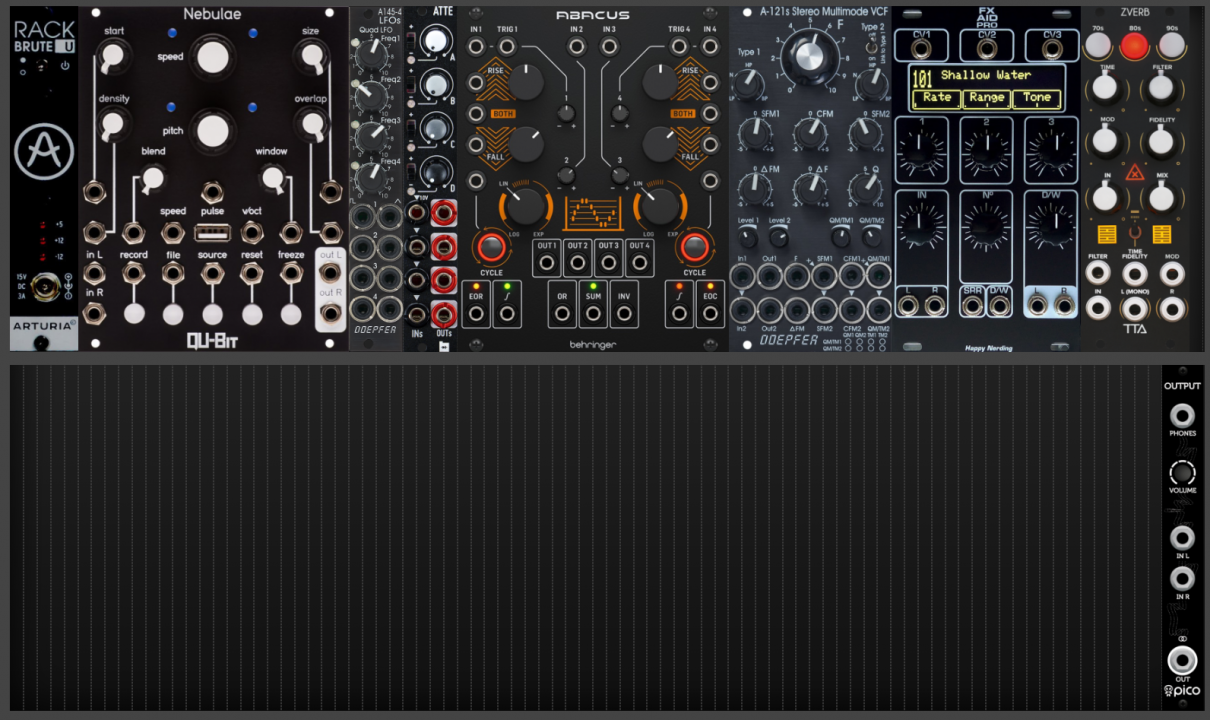
First-time modular guy, but long-time synth guy. I've been lucky enough to play with my friend's modular rig and my favorite piece of kit he had was the Nebulae--we always get great ambient textures out of it. So I wanted to build a rack that's solely for modulating Nebulae and coaxing out great soundscapes, while I likely record it into my DAW and layer some sequences, VSTs, sample libraries etc. on top of it. Hence no clock, sequencers, stuff like that. It's really just going to be a floating landscape (although I'm not opposed to maybe adding some of that stuff in the future!)
You'll notice I have two rows there, the second of which is almost entirely empty. I had planned on just buying a small Arturia Rackbrute 3U, but there was a 6U on reverb for only $50 more and figured I may as well future proof myself in case I want to add more modules. Famous last words...I'm not opposed to maybe eventually getting another sound source (plaits? qu-bit chord2?) so I can feed my sampler something else. But that's potentially down the road and I want to start small!
Everything you see above is already purchased and is coming in the mail soon. Is there anything you think I might miss? Maybe I should get some sort of mult? I considered a mixer, but honestly unless I get another sound generating module I don't think I need a mixer because I'm really just going to be taking a single stereo output through the whole rack and out to my audio interface (hence the little pico out).
Thanks in advance for any help! Go easy on me, it's my first rack!
When browsing My Collection, the manufacturer dropdown now only lists manufacturers represented in your collection. Your previous manufacturer selection is remembered when switching back to browsing all modules.
You can now remove Marketplace notifications directly from your profile without reloading the page. Click the trash icon to stop watching a module.
When selecting your own collection, the search filter should only contain the manufacturers of the modules that you have added to your collection rather than the full list of all manufacturers. Having a more defined collection sort vs. entire library would make sense.
Can only agree with the comment about @mykyta_modular. I just bought a Neptune module from him and had a fantastic experience. Everything was sent exactly as promised, well packed, and with great communication. Highly recommended.
I started my modular journey with quite a lot of 2hp modules, and I'm not knocking their functionality or capabilities, but even slender fingers will struggle to operate their knobs once you have them side by side, with jacks plugged in, with no extra space around them. So careful placement is essential and/or I find it best to use a 2hp Blank between 2hp modules.
I ended up selling about half of the 2hp modules I got when i started due to Phat-Finger-Syndrome! ;-)