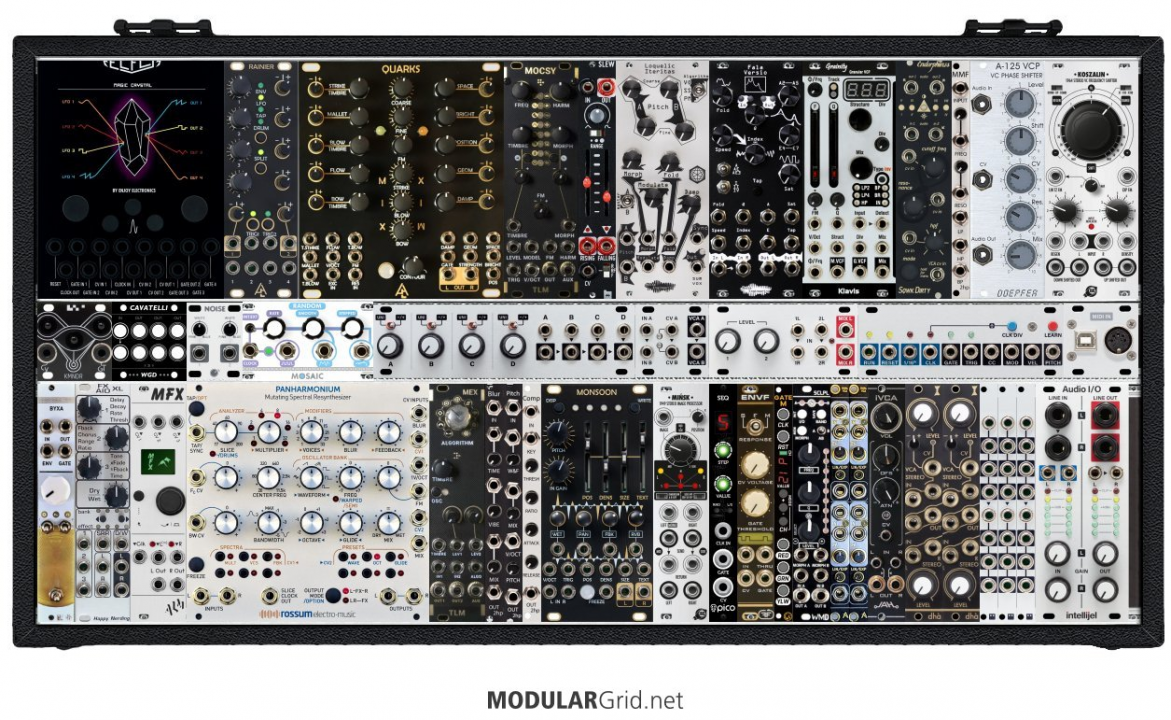
I'm trying to build my first eurorack system focused on timbre exploration, sound design and external audio manipulation.
I've been usin friends' systems for a while so i got to know the basics of the modular world, but there's still a lot of stuff i have to grasp and learn so i was asking for feedbacks on this one.
Am i doing any errors? There's anything important or useful for this kind of system that im missing?
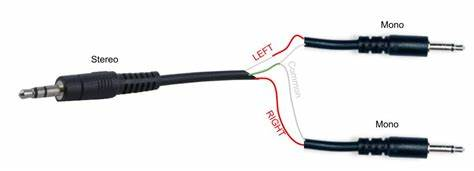
(for example: there are some stereo modules but i dont know for sure if i can patch the signal seamlessly between mono and stereo modules using "stereo to double mono" patch cables)
Any reply is much appreciated, thanks for your time!
this looks similar to the first racks i tried to build on modular grid!
i'm not sure what all of the modules are from the picture but I will give some general advice.
to start pick one effect module to process your external audio. put your audio into it and wiggle the knobs. listen to what happens and what you like. now look at the modulation inputs on the module. which of these inputs can do what you did with your fingers with control voltage?
modulation: start simply and go with doepfer. start with basic lfos and envelopes. listen to what these do to your sound. then add a mixer. mix your modulation and then listen to what it does to your sound. mordax data is very helpful for understanding what is going on but if you spend time listening it isn't completely necessary.
it will take a while for you to understand what it is you want from modular. I'm about two years into it, have definitely wasted a fair emount of money, and I'm now building a serge system. definitely spend time reading the manual before you buy something. it is boring but you will understand what the module does which is always helpful. youtube videos are good but remember more often than not another 5 or so modules are being used to create what you hear. they are not often a good representation of how the module you buy will sound when you're just starting.
it might be worth planning one effects chain and considering what it will do to your sound. if i were you i w0uld go for:
intellejel in/out, a filter, a reverb. after that you can add (modulation as mentioned above then) a delay. try delay into reverb. reverb into delay. move the filter to the end of the chain. etc etc.
I prefer effects modules that do one or two things well. you can browse by function here on modular grid so search for a reverb and sort by popular. there are good modules that aren't super popular but the popular ones are popular for a good reason.
as for the mono/stereo question. as far as i know most stereo modules will duplicate a mono input to both channels. if you want a stereo into mono i would put my stereo inputs into a mixer and take a mono mix out.
I already played with some doepfer modules and thats a really great practice for beginners, but in very short time i got hooked on deep digital modules, thats why i added some to the system even if they are not the best choice for someone who is just starting, but i totally get your advice :D
I also understand why visual representation is very important, Thats why i chose the new ELFO as the main modulation source, I know its very far from being a basic module, but i think it gives unparalleled visual representation and responsiveness with the big touch screen (also one FX module has an oscilloscope and spectral analyzer section so i think i will have enough visual clues since i accounted for that).
About effects, i chose 2 multi FX modules (MFX from busy circuits and FX AID XL from happy nerding) because i usually produce music in a DAW so i like to have a wide range of choice when planning an FX chain, but i totally understand your take on modules that just do one thing, i experienced they can be way more interesting and nuanced than multi function modules!
Thats why i tried to reach a balance between these 2 kinds of effect modules by also selecting Monsoon (a Clouds clone), the XAOC Pitch Shifter, the Doepfer phase shifter and PITCH + BLUR from 2 HP since i really love their sound.
I've selected both kind of modules to get the best of both worlds, does it makes sense to you?
I already know it will take some time to get where i want in modular and that will cost a lot, but thanks for pointing it out! I still have to read every module's manual but i get thats a mandatory step for understanding what is happening to signal and how to properly operate your modules.
About the mono/stereo issue: is it possible to NOT use a mixer for that?
Because there are several modules on the system with separated L and R audio outputs and i would like to patch them into single L+R inputs seamlessly and using a mixer just for that could be inconvenient (For example: Clouds' Outputs are divided in L + R stereo, and i would like to continue the patch on the Grainity filter which has a single input patch point without using an extra module to merge the L and R signal in one single jack cable, is it doable simply by using this kind of patch cables?)
Hi, I will try to answer your question as well as give some advice.
mono/stereo issue: most modules that have stereo outputs will go into mono if you only use one exit. Often the left output. Check the manuals how that works for the individual modules. So you can likely patch Monsoon Left into Grainity. and have all of the sound that was coming from the left and right input. Regardless of how you do it, after the mono Grainity the information will be mono. Running stereo into mono will always result in a mono (=both speakers the same) sound. The cable that you show has a stereo end, your mono modules will probably get no sound from that. I accidently bought some stereo big jack cables in the past and it often causes problems with Moog gear, with my bass guitar, with my effects etc. I'm sure it will be the same with 35 mm jacks.
I see you have three mults. I think you can probably suffice with two and I would also spread them through the system instead of keeping them in a corner for maximum effectiveness. The mults could get your double outputs into one input if the left mono implementation mentioned above is not in the module.
If you want a versatile and cheap LFO, the Eowave Zone B.F. Black Edition is now on Modular Grid for 46 €. That's half what I paid secondhand and frankly a great deal. Run a LFO at audio rate speed in any oscillator or VCA and you'll get interesting timbres. Please note that I'm not the seller and not responsible for the sell.
You have quite a bit of mixing modules at the end there. Mixers are sometimes optional. There is no problem going straight out from a VCA into your DAW/Audio interface if you keep the levels alright. Turning on 'pad' on your audio interface will keep the signal from overdriving. So maybe you can take one of those mixers out. Keep in mind that a Quad VCA is often also already a mixer, there is no rule on what the spot is where you take sounds in and out of your eurorack system. More VCAs is probably better than more mixers.
If you're planning on using the eurorack with the DAW always, then those two multi-effects modules might be a bit unnecessary and boring. You can apply simple end-of-chain effects in the DAW. I think it would be more fun to focus on eurorack effects with lots of modulation options, that would take advantage of the eurorack 'way of working' better.
Hi Stefvan, i confirm im planning to use this system with a DAW as an external audio and MIDI source and with a MIDI keyboard as an alternative MIDI source for a more hands on approach.
Thanks for pointing out the overabundance of mixers, thats because i never worked with stereo audio signals and since i would like to process and mix in the final output both the oscillators and the processed external audio at the same time i thought a certain amount of stereo mixer channels were required, but i inserted too many.
I think im still gonna keep a pair of stereo mixer channels since the quadratt (intelijel 1U quad mixer and attenuverter) doesn't look like the best module for mixing stereo signals ( it has individual amplitude controls for every mono channel so maybe that could bring some light imbalance between the Right and Left signal of a stereo sound, does it makes sense to you? Thats another thing im not entirely sure of).
About the mono/stereo compatibility between modules: thanks for explaining it to me, so if i want to use a mono module i have to exit from the previous module with a mono signal!
Still i don't understand how a mult could get a double L+R input into one output, i thought they are just replicating the signal inserted in the first patch point: are you saying they can mix 2 signals in a single output like in a mixer?
I thank you again for your thoughtful reply and advices, sorry for asking even more beginner questions as a response!
Thanks for pointing out the overabundance of mixers, thats because i never worked with stereo audio signals and since i would like to process and mix in the final output both the oscillators and the processed external audio at the same time i thought a certain amount of stereo mixer channels were required, but i inserted too many.
Okay, but let's say you have something awesome going on and you want to record this to make a track with it. Probably you're going to want to make the final sequencing and build-ups and touches in your DAW anyway, so why not first record your first voice and then your second voice and mix them together when you're making the track in your DAW. For jamming you can put all you sounds through a single stereo out and when it's time to get serious you record the voices separate. Then you only need one stereo pair out and you don't need to constantly use four inputs on your Audio Interface. Makes it also easier to jam with friends on a small mixer. It's up to you of course what you find important and how you spend your cash.
it has individual amplitude controls for every mono channel so maybe that could bring some light imbalance between the Right and Left signal of a stereo sound, does it makes sense to you? Thats another thing im not entirely sure of).
Don't worry about that, you can see it super accurately in your DAW and fix it there :). Maybe it even sounds better with imbalance. I have the Intellijel Triplatt myself and it's great for submixing and fixing/attenuating modulation stuff so I'm sure you will enjoy the Quadratt.
Still i don't understand how a mult could get a double L+R input into one output, i thought they are just replicating the signal inserted in the first patch point: are you saying they can mix 2 signals in a single output like in a mixer?
I just checked it on my eurorack because I confused myself a bit. If I have a 3 mult and I put in 2 oscillators and put the third socket in the Audio Interface then I hear both oscillators. The mult doesn't have real ins and outs. What you put in sockets comes out the other sockets. But here's the thing: in a melody and already enveloped situation I got the sound perfectly. But when I just take the full non-modulated oscillator sounds on the same octave in the mult there's this weird-but-cool noise-cancelation effect going on. So yeah, to be safe submix on the Quadratt and I think most of what you said will be fixed in the module when it outputs both channels to Left (mono). But you can definitely use the mult to put two modulation sources in and use them together at one destination and in a pinch the mult will also work as a equal gain mixer. I have a small eurorack and I like the noisy parts so for me I don't worry and it's 'sound design'.