I ordered a ZLOB Skew fade LFO to @RTFM and everything went perfectly. New module, well packaged and with a fast delivery.
He has a large number of DIY modules, perfect for those of us who are not good enough with a soldering iron.
Highly recommended seller.
If you want to post a link to your rack, just click on your user name, right click on the link to whichever rack you want to show, and then select "copy link address".
Interesting, thanks for the response. I suppose I would agree that it's very connected to all of those variables (goals, style, size, etc.). At the moment, my system is still relatively small (https://cdn.modulargrid.net/img/racks/modulargrid_2086285.jpg - how do I post a link to my rack rather than the jpg?), so I think part of my issue is that I can't work around an existing patch too easily if I want access to a module. The other part is that I'm just an impatient person (sigh).
The temporary nature of patches is part of the fun for me, but as I said, I'm starting to realize that maybe I'm not actually exploring them deeply enough before I remove the cables. But as each patch is a learning experience, I suppose that it's just a matter of gaining more experience with my modules and my own workflow.
The last module on the The Human Comparator 73-75 Homebuilt #1, looks to be an audio output. I cant find an equivalent module from Prism at this time. So have just used another brands out module. I don't suggest using that however. I think the best approach is to talk to Prism about creating an out, using a modified version of adapter, to convert to 1/4 jack out. i suspect that the THC out is a mult to mono out with an attenuator on it. We could ask someone to find out.
I know I'm not typical but if I come up with something that I know I'm going to use on a track I'll definitely leave it patched up for months at a time. Yes, I'm a slow worker haha. If end up needing to use some of the modules involved then maybe I'll write the patch down before disassembling it. But I have a pretty large system so that's not always necessary. Anyway I think this kind of thing is highly individual and just depends on your goals, your method of working, the size of your system, etc.
General question, but I'm curious how long you typically keep a patch before starting a new one? Additionally, how do you know when you've fully explored your patch and are ready to move on to something new?
I find that my patches only last between a few days to a week before I feel the urge to explore something new. I realize that I'm most inspired when building a new patch, rather than returning to the befuddling spaghetti of an older one. However, as my rack and experience grow, I'm finding that there are seemingly infinite variations to explore within each patch. Also, I've read several posts of people who keep patches together for weeks or even months! Due to that, I'm starting to wonder if I'm exploring each patch deeply enough, and if my lack of inspiration with older patches actually comes from a lack of knowledge.
How do you know when you're "done" with a patch and ready to move onto greener musical pastures?
Do you have any strategies that you when use to explore your patches to ensure that you've squeezed out all the music you can from it?
Worth noting that the tank that comes with this is huge! Doesn't fit in my LC6 case, does produce a nice long decay though... this is a quality spring reverb. Befaco make great modules.
-- wuhnder
can sound well in different setups. Its low end can be used to fill a simple Basseline. in general it as not many sound variations but ist stabel and very handy to use.
There's something I really do not understand about this module.
Why are the effects individually stored on proprietary memory cards? Couldn't they be stored on a USB drive or an SD card and loaded to internal memory as needed?
-- fabulis
If they stored them on USB drives or SD cards, they could be easily copied.
I have 1 very nice case from lake, it is big, and kind of too awkward / heavy to move much.
I am getting another Case From Lake, it will be a joinable pair, more HP than the first, but also easier to move due to its being a splitable / joinable pair. If you follow up with Alberto at CFL and ask about some pairs, he'll show you some pictures.
I'm looking to get an extra large, closeable, ~portable case. It's ok if it's bulky and couldn't possibly fit as a carry-on on a plane, but I hope to transport it in a car and occasionally clear it off my desk and store it in a corner/closet. Major bonus points if it can be closed while patched.
I like having 1U rows, so I've discussed a custom build with Case from Lake about adding two 1U rows to the middle section, bringing it to 17U 126HP. This is totally feasible and really a dream case for me. I want this to be my main case for the next 10+ years. I may make the big investment in it sometime next year, but I am concerned about power. I want to hear others' thoughts and get my math checked before I go really overboard and compromise or spend extra money unnecessarily.
The case would come with three power supplies by default, powering the top two rows, the middle three (1U + 3U + 1U), and the bottom two. It has quite a few power-hungry modules. In my estimate, I could be using up to 1850/795 mA (12V/-12V) per power supply based on the totals in the last two rows.
Case from Lake says the default power supplies (Meanwell RT65Bs) can go to 2000/800 mA without overstressing. 795 mA is very close to 800 mA on the -12V rail, which is why I'm concerned. Maybe some modules have under-reported power usage, or maybe I'll buy even more power-hungry digital modules in the future. I don't want to have to compromise the rack's layout and be worrying about power if I'm going to invest in this.
So I could add an extra power supply to the top section and the bottom section. These Meanwell RT65Bs are pretty cheap, so that doesn't seem like a big deal and might be enough to address my concerns.
Alternately, I could "upgrade" to the Doepfer PSU3, but that supports 2000/1200 mA total, so using the "80% rule" it might start overstressing at 1600/ 960 mA, which is definitely not enough. I'd probably need five Doepfer PSU3s for this case, but those are significantly more expensive and it looks like it might add something like $900 to the cost (practically doubling the price). It seems these Doepfer power supplies are really well regarded, and part of me thinks if I'm going to invest in this as my main case for the next 10+ years, I am willing to spend more for very high quality that I can depend on. I just don't know if it's worth it... Maybe there's (more) detectable noise with the Meanwells? I've heard stories of certain digital modules using a spike in power at boot-up and not working with lower-end power supplies, but I don't know if this is something I should even be worrying about (is this actually a problem for many people?) or if Doepfer vs Meanwell is meaningful for these concerns.
Ooooor, I could get the mdlrcase 14U 126HP case with its 85W power supplies that can provide 4000/2500 mA to each 7U section. These cases seem pretty nice too! I'd be sacraficing a 3U row, but these seems to give plenty of power headroom at a better price point than five Doepfer power supplies. A big question here is if the mdlrcase power supply is significantly better than a couple Meanwells, and if that would make it worth dropping the 3U row.
In summary, things I'm considering:
Get the Case from Lake case with the default three Meanwell PSUs, knowing that I am riding the line of overstressing, but also knowing I could simply not fill the case (probably a good idea anyway?) or learn DIY skills and upgrade/add the PSUs myself later.
Pay a little more for five Meanwell PSUs. Replace them later if there are any issues.
Pay a lot more for five Doepfer PSU3s instead of three or five Meanwells because I want it to be super-dependable
Stop debating all that and just get the mdlrcase with its overpowered PSUs, but lose some rack space.
If you read this far and are willing to share some thoughts, thanks in advance!
There's something I really do not understand about this module.
Why are the effects individually stored on proprietary memory cards? Couldn't they be stored on a USB drive or an SD card and loaded to internal memory as needed?
-- fabulis
Weirdly, I kinda like this limitation. I like that it’s one-at-time, that they’re sort of a series of little collectibles, and that you can tell by looking what effect is loaded.
That said, you’re probably right that it’s inefficient. 😆
I just received my Klavis Quadigy (what a beast!) from @frits - the deal was super smooth, great communication and very careful packaging, recommended trader :-)
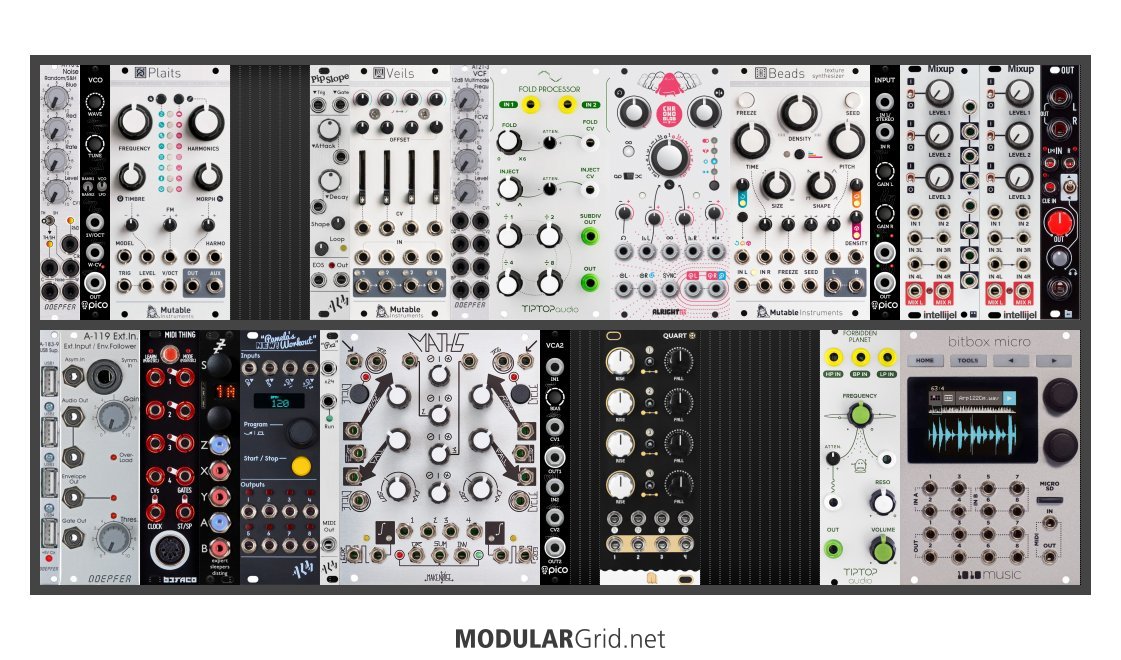
Please review my rack and comment. My intention is a performance case with both structured and unstructured elements that use macro changes to influence movements over various voices. I can also bump some techno.
Tarot seems to be a great module, like everything else that Modulaire Maritime does. It wouldn’t be a bad idea for getting new timbres and sometimes a deeper or more aggressive touch. I would go with that. But the choice of one (or more) module is mostly dependent on the musical direction you want to go in.
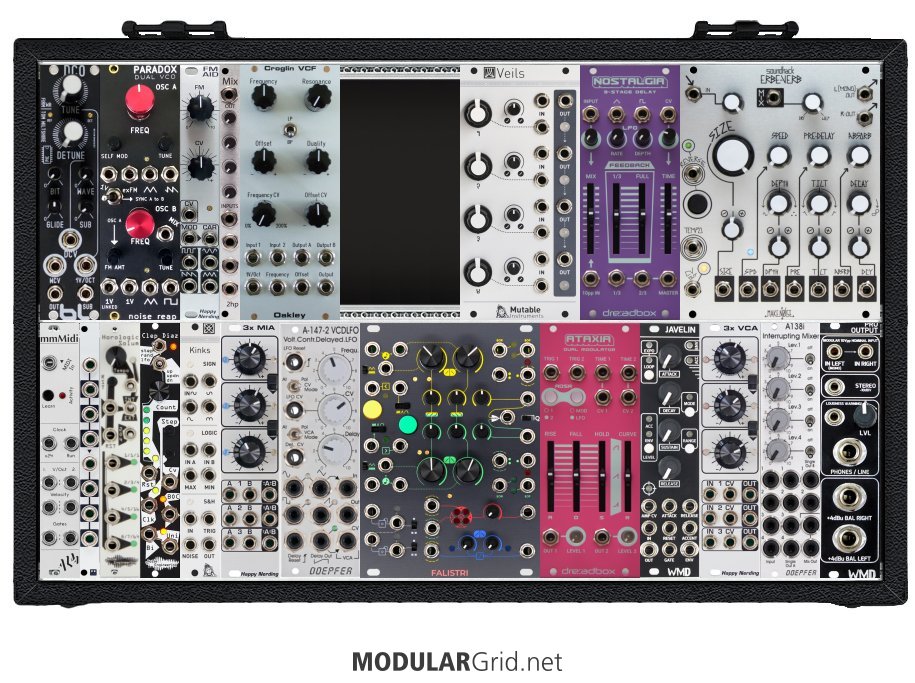
I have questions about this 2*84hp rack : I have all those modules but the A138i, Alm mmMidi and Happy Nerding 3xVCA. And there is a big hole in the middle.
Do you think the A134i will be enough as a global mixer here ? or do you have any recommandation ? x-pan ?
What about the big hole ? any idea ? a multimode filter like Filter 8 ? a waveshaper like the Tarot from Modulaire Maritime ?
The After Later QARV is also black and is, I think, terrific value for money, in that it gives you four attack/release functions and some basic mixing, as well as a 5v and 10v offset (so, somewhat similar to a Maths), but ALSO four VCA’s. If you stick with the 62 hp effects rack plan, you may not need the VCA’s — but if you add anything else at all, they’re very handy.
Appreciate your feedback, Jim -- had no idea the Maths with the black faceplate are this rare... color is inordinately, nonsensically important to me (I'm, somewhat sadly, not being sarcastic) :/
Totally hear you on the rack size. Iono why, but for whatever reason the Mantis looks... kinda ugly to me. I do think you're right and eventually I'll have a need for a larger one but this one's good for the moment. Pretty sure this is my version of golf and I'll just have to keep upgrading as long as I can afford it :)
get a bigger case - perhaps a mantis - not only much better value for money, but you will need it eventually - which means you may end up only buying one case...
don't expect to get a black maths - they are unobtanium - generally only available as part of a shared system
"some of the best base-level info to remember can be found in Jim's sigfile" @Lugia
Utility modules are the dull polish that makes the shiny modules actually shine!!!
So, they removed the PPQN x08 setting from the clock menu.
It jumps from x4 to x16 with nothing in between.
My entire Live setup relies on Hermod clocking Pamela. And Hermod's clock can only output 1/32, 1/16, 1/8 and so on.
Meaning I had to swith from a 1/32 (wich requires the x8 on the receiving end)
to a much slower 1/16 clock on hermod with a PPQN x04 on pamelas PRO workoout.
But oh boy does that not work. Pamela takes a beat or two to even start and then it does so on some random 16th note. Never on the actual downbeat. And tempo is constantly drifting a few BPM.
Just for shits and giggles, I connected both pamelas to the same clock/reset signals.
Pams New Workout is stable. very much so.
Pams PRO Workout doesn't seem to know what a clock is.
How come?
Has anyone else got the sync problems with pams PRO Workout?
Anyone knows of a good a Pams PRO Workaround or something? damn....
I'm new to sound synthesis, my first synth is a Moog Grandmother which I got about a year ago. Really want to delve into the world of modular and be able to get a lot more ambient-y, noisy and drone-y effects to it. Haven't really devoted any space or modules to synth voices as I'll still be using the Moog for that purpose, but I was curious to hear any thoughts, opinions, suggestions that you might offer if you were aiming to do something similar?
It’s 5 pins an the colour scheme on the cable is identical to the colour scheme on pexp1‘s cable. I am tempted to try hooking pexp1 up to pams pro! 🤣
-- nemoy
I would probably try tracing them with a 'scope or logic analyzer first, just to be sure...
(The signals would be always-present if it is the same, +5/run/x24/midi/gnd)
Ok, I got myself one. It has two connectors… one labelled „expand“ and the other one „midi-ex“ i guess thats gonna be the name of pamelas new midi expander…
It’s 5 pins an the colour scheme on the cable is identical to the colour scheme on pexp1‘s cable. I am tempted to try hooking pexp1 up to pams pro! 🤣
Oh wow, I just found the little side note about Pro Workout NOT being compatible with the PEXP1. damn.
Is it just a different connector, and could be somehow connected with a little bit of hacking and knowing the exact pin outs? or is it a completely different thing?
Also, are we limited to one expander at a time? Like axon-1 only?
-- nemoy
The sales copy seems to indicate that the AXON port and the future output expander port are separate. The AXON ports on other ALM products only connect one at a time, as did the output expander port on PNW, so I'd expect it's one-of-each.
Oh wow, I just found the little side note about Pro Workout NOT being compatible with the PEXP1. damn.
Is it just a different connector, and could be somehow connected with a little bit of hacking and knowing the exact pin outs? or is it a completely different thing?
Also, are we limited to one expander at a time? Like axon-1 only?
very helpful, thank you! I think I'm going to replace the Ruina with two WMD 4TTEN then.
And yes, I'm aware of the limitation of the OPTX inputs, but that's not a problem for me as I definitely want to avoid the integration of the software part again. That's why I'm coming back to real synths in the first place. I'm going to record and remix the audio tracks on Bitwig though.
probably the best way to do this is to slave Pam's to Ableton (or any other DAW)
create an audio track in your DAW and paste a kick drum sample on every 16th note... send this to an output on your audio interface - you may need to mess around a bit with volume to get it to work properly
save this as a template - so you can use it for other sessions in the future - tempo should properly match session tempo, it does for me in Logic
patch the audio output to the clock in on Pam's and set up Pams to use 4ppqn (parts per quarter note) and to run/stop on receipt of clock
this will give you much more solid clock than using midi in (audio always has higher priority in computer operating systems than midi)
"some of the best base-level info to remember can be found in Jim's sigfile" @Lugia
Utility modules are the dull polish that makes the shiny modules actually shine!!!
I am thinking to start including Ableton into my setup (which i've never done before to be honest).
Now, i still want to use Pamela New Workout as master clock driving my eurorack sequencers, so i need to find a way to slave ableton to Pamela.
The modules/gears which i have are:
PAM
Polyend Poly2 (Midi to cv)
SSL+ (audio/midi card)
Mac running Ableton
Now, i am wondering how can i send PAM's clock to Abeleton. Not sure if the Poly 2 can pass the clock to Ableton using one of the gate and the midi out.
Anyone has experience whit does modules and this setup?
Both the BIA and 4ms Ensemble will benefit greatly from attenuation on the inputs. There is no built in attentuation on the BIA, and only some of the inputs on the 4ms Ensemble are attenuated by the module itself. I've got attentunation modules next to both of these in my setup.
The OPTX works great with Bitwig for sending additional pitch, modulation and triggers to your rack. But the inputs are AC only - works fine for triggering Bitwig from your rack, but you'll need to use the Grid to modify incoming CV signals to get Bitwig moulations that are related to those coming in from your rack.
Hi,
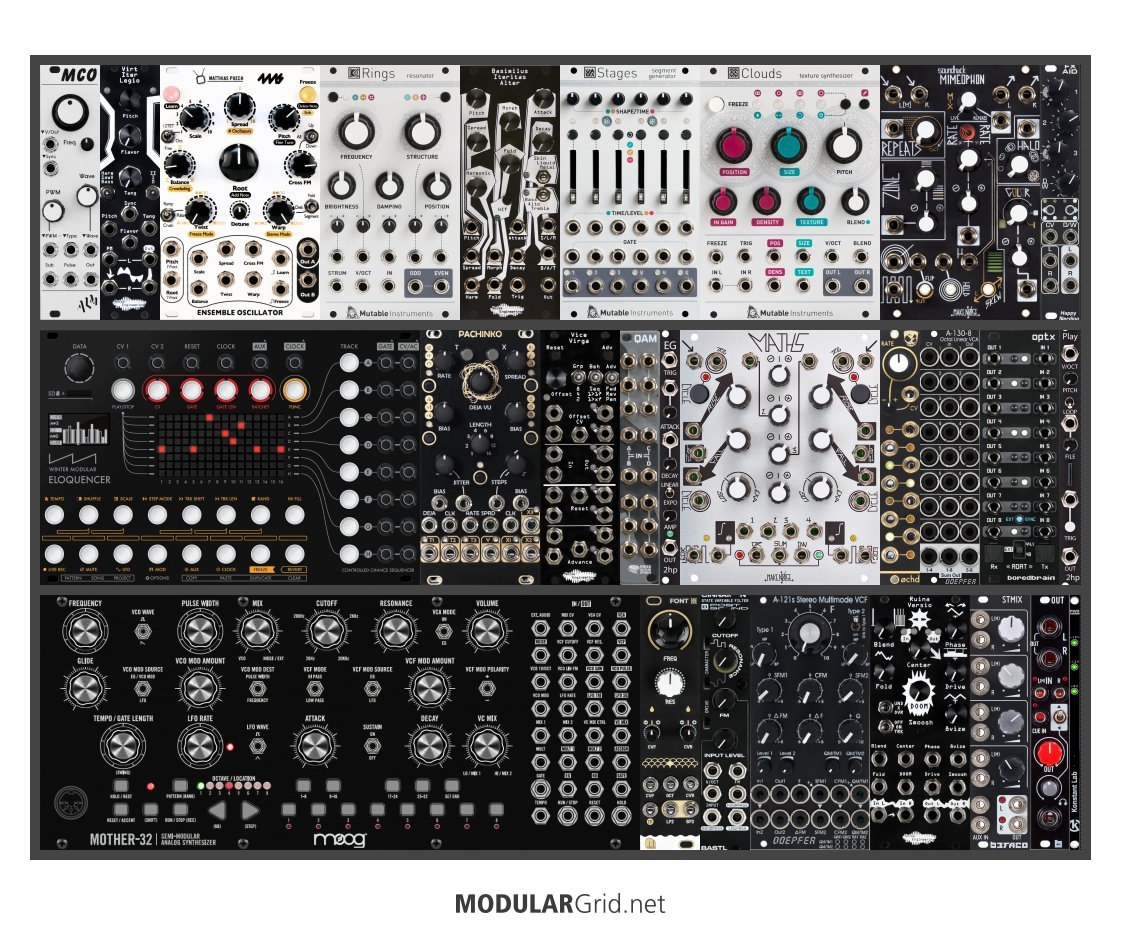
Dieter from Germany here (a different Dieter of course). I'm starting with modular again and eventually came up with this rack (MI modules will be replaced by clones). My musical style is rhythmic, repetitive, semi-composed / semi-chaotic; sort of heavily cranked up Berlin school.
I'm going to perform live as well as record on my beloved Bitwig via the optx and I'd like to have an all in one portable package.
I'm interested in your opinion. Did I miss something? Thank you!
Regarding Rhythms generation,
Shakmat is really great at this. Knight Gallop and Four Bricks are amazingly powerful.
I agree with the above: looking for clock dividers/logic is a very fun approach to patterns generation. 4ms clock dividers are feature packed. Shakmat time wizard combines dividers and logic.
I agree too that Befaco Percall is great.
Also look at sequential switches.
For sounds this really depends on the sounds that you want to achieve. Endorphin has nice multi voice modules. But there are many options to listen to.
A square wave osc , a noise source and a good filter can do a lot :)
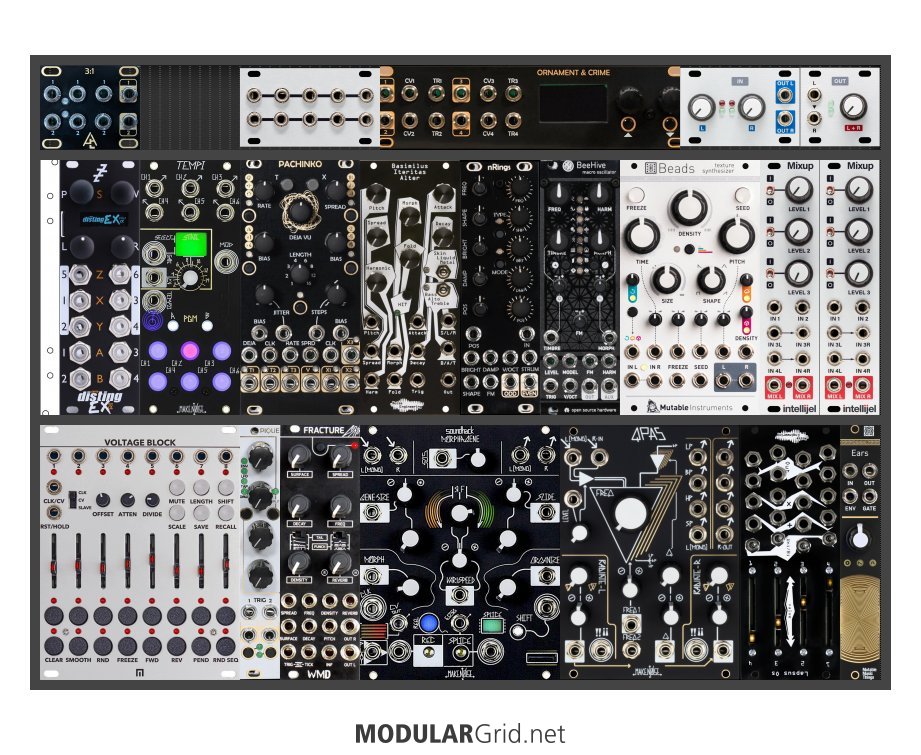
I'm working with a couple of musicians playing reeds and I want to be able to provide percussion, bass lines, and sometimes the odd countermelody. Please check my case and let me know what you think.
The concept is to maximize CV modulation that I can adjust, create, transform in realtime. The ability to save some sequenced things on the fly (and in studio) is also an asset. So I had MATHS, but found I couldn't justify the rack space to have that as the main CV source. I find it too 'brainiac' for me. I need something that I can set in motion and transform. Thus the Voltage Block in the place where MATHS used to be. Plaits, nRings, BIA, and FRACTURE are the main sound sources, with distingEX and/or Pique when they are not being used for other purposes. o_C (Hemispheres) will of course do whatever needs doing that the other modules haven't done. Although I have the classic two menu-diving modules (EX and o_C), I'll likely use them for their functions, turing and other stuff like that that is more or less set and go. Audio feed from my Zoom L-12 mixer will be the sound source (my reed musicians) for MORPHAGENE, possibly mixing that signal with mixup #1 sources from the rack. Control is Voltage block, Pachinko, Tempi, (and/or distingEX, Pique, o_C if needed).
So far I have had great success just using what I currently have, which is the rack I link to above without Pachinko and Fracture, nor the AfterLater little line sum at top left.
Due to the evolutionary compositional concept, my main sequencer is now the Torso T-1 desktop module, which I have controlling the pitch modules (Plaits, nRings, BIA). I need Voltage Block and Pachinko for percussion.
By the way, audio out goes to 1010 music bluebox, where other synths are also patched in for use in larger setups. For using the rack standalone, I am relying on the Beads reverb as my endpoint. I realize this is a bit limiting, but I do have an H9 and/or STRYMON nightsky for final processing of the audio out from the rack.
The best advice is to start slow. Get only a few modules at a time. Learn them and figure out what modules to get next as you figure out a workflow
Just spitballing modules that I'd want to include...
Sound Generation:
Quad Drum + Qex expander or Erica Synths LXR should be on the top of your list for drum sounds. Either of these alone could start banging out beats with a sequencer (like Beatstep).
Basimilus Iteritas Alter is THE king of kicks, but Kickain is a newer option that looks really good too
Check out Percall if your thinking about creating drum sounds from "scratch" with oscillators and noise
Sequencing:
Euclidian Circles
Varigate 8+ with Voltage Block is an incredible combo for sequencing gates and stepped modulation
Check out the full suite of 4ms clock modules (+ expanders). Rotating Clock Divider is an all-time favorite. Quad Clock Distributer and Shuffling Clock Multiplier+ are all amazing. Pingable Envelope Generator for modulation
There's a lot of rhythmic fun to be had with gate generators like Grids, Zularic/Numetic, Knights Gallop and Moffenzeef MITO. Add in some logic and sequential switches for more variety.
Pamela's Workout is useful in every rack
Mixers:
Jumble Henge
Tesseract mixers + output module or Cosmix
Effects:
Tons of great choices for multi effects or specialized reverbs/delays. FX Aid sounds great and has many algorithms.
Been a year since i first posted here and started into modular - So this is where I am at with my build - I have everything on the top row and everything from left to maths on the bottom row. pretty different than my initial plan but its warped and molded as I've been playing with it.
tempted to fill that 8hp with a second pams, but i technially still have the bottom right half to play around with new modules (pretty set on the far right modules though; qx to addacs.)
externally sequencing with the opz - also using for guitar, not really using for performance at all, just experimentation and sound design.
Just thought i'd share and see and get impressions/feedback
I have a 150HP cabinet coming in very soon. This cabinet will be used to house a modular drum machine/pattern generator/sequencer with an emphasis on performance. Live performance, that is. Ideally, when this thing is complete, I want to be able to program rhythm patterns on-the-fly, trigger pre-programmed rhythm patterns, trigger algorithm-generated rhythms, or any combination thereof.
My first challenge is to choose a decent drum sound synthesizer/sampler. It would be nice to have the capability of using sampled drum sounds but sampling is not a must-have. A drum synth that can generate great percussive sounds is acceptable. Or some module that combines the two would be even better. Eight voice total polyphony is my desired target.
For on-the-fly rhythm programming and the triggering of pre-programmed rhythm patterns, I could just use something like an Arturia Beatstep Pro, a Korg SQ 64, or something else that I may not have yet considered to control the sound generators that will eventually populate this rack. But when we get to algorithmic drum pattern generation, I really don't know where to even start looking.
I figured it would be a good idea to ask someone who is a lot smarter than me. And this exactly why I am here. If you had 150HP of rack space to dedicate to the ultimate modular drum machine for live performance, how would you build it? I welcome your insights and thank you for any help you may be able to provide.
There's something I really do not understand about this module.
Why are the effects individually stored on proprietary memory cards? Couldn't they be stored on a USB drive or an SD card and loaded to internal memory as needed?
Thanks guys!
Those are actually pretty good ideas, I know I'm way too much into effects...
I'm going to have a look at what you suggested, thanks again.