
Thread: Sebsongs Modular ODDS
Ladik also has the Composer N which is one of my favourite modules. I can heartily recommend it. I do think Sebsongs will also offer prebuilt units at some point in the future, if I am not mistaken.


Ladik also has the Composer N which is one of my favourite modules. I can heartily recommend it. I do think Sebsongs will also offer prebuilt units at some point in the future, if I am not mistaken.
Hey, I modified your upload a bit and merged previous versions together. Thanks for the upload!
The discussion on MW is pretty cool, and it is looking to be a cool module. I am considering supporting it as I like the visuals. Hope they include some of the suggested modes (wink wink).

Hi, it would be helpful if you could tell us what kind of music you intend to do.
IMO, I would set up a mixer with at least 4 channels just for audio, and I would leave the triplatt for modulation. I don't see any percussion, are you going to use any external equipment for rhythms? Are you going to use rhythms? ;-)

I start the modular. I need feedback on what I want. Can you give me your opinion ?
thank you

I ordered a Intellijel TRIATT to @timoka and everything as described.
Well packaged and a fast delivery.
Highly recommended seller.

I just added this module to ModularGrid:
https://www.modulargrid.net/e/other-unknown-bela-io-gliss-
I found the discussion on MW where it's getting a lot of interest. The developer is really listening to what people have to say. For example, some found issue with the connectors at the bottom on a controller. The developer decided to implement an upside-down usage mode. Consider me interested as well!

Great question!
For me it depends on what I'm doing in the studio in general. I have a lot of equipment and I write with modular gear based on if it fits with the composition or not. That said, I have a fairly good sized set of racks (check my racks, they're all public) and I find that sometimes I'll leave a patch I really like wired up for a long time (never for months). If I need to move on, I snap photos of the patch, and make a video recording so I know what it was about the sound that I liked. It's also a good way to see the patch wiring, the knob positions and so on. That way if I want to attempt to recreate it alter, it's way easier.
I'm actually trying to get to a position where I can have the minimal number of modules that have the greatest versatility. I have somewhere around 100+ modules so it gets a bit frustrating knowing that I have any handful of modules that will accomplish the same things. I like making music way more than I like fiddling around with my rack setups and wiring!
"I'll just plug this in here and see what happens."
That's a hell of a disciplined way to learn, wow. Those are cool tracks, by the way!
Thanks! It takes a bit of discipline, yes, but the reward is very large indeed. It also buys me a lot of freedom as I hardly feel any attachment to what I make. Which allows me to do crazy stuff, like today's experiment with a 5-beat rhythm. That's completely new for me, so a quick track later I know a bit more of the possibilities.
For some occasions, I leave the patch a bit longer. For example, there was a modular meet on Sunday. I started the patch I presented there on Thursday and worked on it until Saturday, leaving it intact for the day after. That's something I've been considering exploring more of. Building up a number of elements, then recording it as a jam. I notice it allows me to explore more complex patches and song structure.

hello to all here, my first post in the forum;)=
as stated on modwiggler and as you know, the OFFSET function on the Metropolix works as this:
example pattern: active stages 1-2-3-4 with modulations -> OFFSET +2 -> active stages then 3-4-5-6
Wouldn't it make much more sense if the result is after OFFSET +2 -> active stages 3-4-1-2
which means, the starting point of your pattern has rotated 2 stages to the right but WITHIN your pattern,
so you can adjust it to other sequencers etc ?
As it is now, you lose your pattern or have to re-program it, but what's the point then with an OFFSET ?
(also it would be nice, if the modulation lanes like ACCUMULATOR, RATCHET, etc could be (CV-)rotated
seperately, without the stages, but that would be another thing)

BD-Z drum module kit from Patching Panda build and demo
A bass drum module from Patching Panda with lots of modifiers. Excellent sounding unit, and flexible.
Not a lot of electronic building, this I primarily a surface mount kit with all the SMD components pre-installed.
But still lots of knobs and jacks to put on.
I start the modular. I need feedback on what I want. Can you give me your opinion ?
thank you

@RTFM: highly recommended. Bought a Turing Machine with expanders. Since then, he's helped me a lot with DIY. Great guy to deal with.
I ordered a NONLINEARCIRCUITS Dual LFO/VCO to @RTFM and everything went perfectly.
Well packaged and a fast delivery.
Highly recommended seller.
-- ferranadsr
I ordered a NONLINEARCIRCUITS Dual LFO/VCO to @RTFM and everything went perfectly.
Well packaged and a fast delivery.
Highly recommended seller.

Awesome, thanks for the tips!

apologies if this was already posted, couldn't find anything through search. i was looking everywhere on the web too before without any real success.
volca is a nice little box, but the lack of inbuilt bpm counter is a real downside, especially because it can fully connect only to other volcas, that's kind of unfair. so the setup for this topic is volca modular + behringer netron + arturia keystep 37. i'm avare of voltage differences, but this isn't the question here. however tempo sync should be possible i hope. i tried sync out of keystep to volca's sync in while keystep's clock as in manual is set to internal mode. this doesn't even allow to play previously recorded sequence on volca. any ideas?

Hi, somehow the pictures of my racks aren't updating anymore in the the racks overview page. For example after I modified a rack and go back to the Racks main page, the changes are not visible. Refreshing the rack view repairs it temporarily, but if I go out of that page and get back, the rack is still the "old" version. Any clues of what I'm doing wrong?
Another option is users here who assemble any diy kit for you. I have already bought two from the user @RTFM and I am very happy. You can ask him how much it would cost you assembled, and if he doesn't have what you're looking for, he can always assemble a Music Thing Modular module (Turing machine) that can give you similar performance.

Disting Mk4 algo F-6 (Shift Register Random Quantized CVs) is pretty similar, and of course it can do a ton of other things as well.

Hi HGsynth,
Yes, by times I start always using the same approach however I don't mind to let go an (old) idea and start with a totally different approach. So on average I think that keeps things in balance. Once and awhile (especially when I am lazy) I start with the same (start-) setup and then evolve from there the patch however also on regularly basis I start with completely something new, never done before so to speak. Especially when I get a few new modules, I like to try a complete new approach and take it from there.
To summarise this: it really depends on a per case situation, sometimes that, sometimes something else :-)
If you recognise already the fact that you always start with the O_c as your starting point, then one day when you want to do a complete new patch, "forbid yourself" to use the O_c in the upcoming new patch and just try something completely new not remotely related and close to your usual O_c approach. Dare to try something else, and you will see after a few times you forgot you have an O_c ;-)
Have fun with the patching and try things you never tried before, don't care about the result, if it doesn't satisfy you then try again from scratch, till you find something that surprises you and you like, keep then that kind of creative approach in mind and try that approach in a similar but different way! :-) Kind regards, Garfield.
For review reports of Eurorack modules, please refer to https://garfieldmodular.net/ for PDF formatted downloads
For me it's a bit different. To keep myself away from TV, I committed myself to making a new track every day. So every evening, I pull all the patch cables and start from scratch. 2-3 hours later, I post the result on SoundCloud. I've been doing that since March. I can tell you, it's a very fast way to learn a lot about patching techniques.
-- Arrandan
That's a hell of a disciplined way to learn, wow. Those are cool tracks, by the way!
I feel that this approach is somewhat similar to mine; each time I patch I try to find slightly different ways to connect everything to avoid a rut where each patch sounds the same. Also, after a few days, I'm usually out of cables and decide to start anew out of boredom (there's that impatience I was mentioning earlier). I also sometimes purposely limit myself to a small selection of modules, both to push myself by setting artificial restrictions to work around and to counter the impulse to use every module and cable in every patch.
@GarfieldModular, thanks! I remember you saying in another thread that you predominantly do generative stuff. Do you typically find that you start a patch the same way each time? For example, I've realized that I rely too heavily on O_c's shift register and quantizer to start a patch, and am trying to avoid being overly reliant on that same signal path.
Appreciate all the feedback, everyone!

Anyone knows a pre-build alternative for this one? Love to get one but have the soldering skills of a 6 year old.

Oh and regarding the "pedalboard pedals": This is clearly a sign that users need more pre-defined pedalboards. (So do I, the plywood sucks so hard...) Perhaps there could be even something arranged with the board manufacturers, it could be a nice lil advertise to have the boards available like that. I mean... Temple Audio even built something on their own with templeplanner.com.
Something on the pedalboard is out of scale. I created a 820x320 pedalboard using the plywood background and placed two devices with a height of 184 and 140 on top of each other. Visually it looks like there's even space left but in fact it's already exceeding the board dimensions. I almost fell for it and ordered the wrong board!
Please don't kill the synths, mixers, sequencers and other useful stuff. A pedalboard is a super useful vehicle to build portable live synth setups and MG really helped me planning with building mine on a Templeboard Trio 43. But I agree that trashy/bad stuff (Madagascar...) should be deleted. Maybe add a reporting feature?

you mentioned a "hiss problem", when working with ES-9 and Morphagene or Mimeophon... what exactly is the problem there? Do you know, where it is coming from?
It's actually not related to the ES-9. The hiss problem has been discussed at length on Mod Wiggler, for example in the main Mimeophon thread. I'm not sure if the cause of the hiss has been identified.
You can hear the hiss at 00:54 here (not my video):
I have tried the modules in both an Erica Synths 6U Monster Case and a 4MS 40X Pod, and the problem has been present in both configurations. I will soon try with a Meanwell 120W PSU and Konstant Lab HammerPWR with a filtered bus board. I'm in Europe.
-- ecstatic_sutherland
Just a quick update: the hiss is still present with the Meanwell 120W PSU and Konstant Lab HammerPWR with a filtered bus board power solution.
For me it's a bit different. To keep myself away from TV, I committed myself to making a new track every day. So every evening, I pull all the patch cables and start from scratch. 2-3 hours later, I post the result on SoundCloud. I've been doing that since March. I can tell you, it's a very fast way to learn a lot about patching techniques.

Falta algo que seleccione las diferentes partes de frecuencia de los sonidos
Hi HGsynth,
For me it's similar as it is for Adaris. I also keep my patch usually for several months. Till I really can't find any more any variations on what I like and then I might start a total new one. I usually just keep on extending while finding other sounds, on the already existing patch. Meaning that it becomes at the end very complicated, most of the times most of all my patch cables have been used and then sooner or later (but rather later) I am forced to start completely from scratch. :-)
Have fun with the patching and modular in general and kind regards, Garfield.
For review reports of Eurorack modules, please refer to https://garfieldmodular.net/ for PDF formatted downloads

"I own the Pico out and it's a great module, I throw it in tons of cases, but the odd hp size and the tiny pot drive me nuts. To counter the odd hp I usually pair it with 1 or 3 other Pico modules. Recently picked up a 1 hp blank to fill in the gaps if I find myself only able to use 1 Pico unit. That's all personal and ocd related, but worth considering. Have fun!"
Aaaahh.... I am little OCD myself, in fact, so actually this is a damn useful observation!
It will take a little while before I fill my 84hp so I have a bit of leeway and hopefully everything will add up (as mentioned elsewhere I rather like Pico too), but in the meantime I'm looking to get a little set of acrylic or perspex blanks cut.
Partly to hide as much Behringer as humanly possible. If I get them done in clear or smoked effect perspex, I can use the same material if I get into it and need a bigger case!
I'm excited af to get my Weather Drones so thanks for singing its praises, I look forward to some weirdness in my life. Peace!
Okay that's cool, you're basically confirming what I thought re: basic signal path, maybe seems like I'm too hasty wanting to add a second voice before I even understand what I'm doing with one, especially given what you and yeahivandalizm have said about WD's functionality.
Sequencing in-rack really fascinates me, but yeah, I'm also thinking about a Beatstep since I already use Ableton, hmmm.... as always, Pico and Ladik, thanks for the practical suggestions. Pico Seq would match the out I got for headphones... I will update this thread as I go ofc...
Cheers 33PO! You've really helped.

Excellent choice with the weather drones. I started with a semi-modular, and after getting into it for a while I got the weather drones. I quickly realized that would be the perfect choice for a first module. It's a really good combination of musically usable and modular weirdness. For your output you might want to consider a noise engineering sono abitus. At the time of writing this NE is running 15% off on their site. Same functions, but ¼" Jack's, bigger sturdier knobs, and 4hp instead of 3hp. I own the Pico out and it's a great module, I throw it in tons of cases, but the odd hp size and the tiny pot drive me nuts. To counter the odd hp I usually pair it with 1 or 3 other Pico modules. Recently picked up a 1 hp blank to fill in the gaps if I find myself only able to use 1 Pico unit. That's all personal and ocd related, but worth considering. Have fun!
edit
After re-reading, looks like you have the out already, my bad lol
Suck it, nerd

It's possible that I misread the specs, but Weather Drone seems like it's a full synth voice. If that is the case, all it really needs is a Keystep (or Beatstep) to get bleeping/blooping melodic note sequences right away. It could be done with the Keystep's onboard sequencer, or drive the Keystep CV outs from Ableton
The output module is nice if you want to connect headphones directly, but it's not necessary if you already have a mixer or sound card for your computer.
A basic synth voice would be:
Oscillator - Filter - Envelope - VCA
All of the above appears to be included in Weather Drone along with an LFO, sample and hold and some other nice bonus stuff.
If you want to keep sequencing in the rack. Check out the full line of Pico and Ladik modules. They have some great budget minded gate and CV sequencers.
Pico Seq is a personal favorite of mine.
Nice! Here we run into one of the problems of modular that's already becoming apparent to me: SO many tempting modules, SO many ways to modulate and process...!
Literally all of the options you outlined appeal to me in one way or another, and I 'm intrigued by the idea of paired modules.
Probably the most budget-conscious option is one Pip, second Pip, then... probably MISO, which I really like the look of over O/A/x2. The QARV is another module like the look/feel of, so I'll be sorta keeping an eye on a bunch of these options on the wait'n'see principle over the next couple months, so another good shout there.
My last question... with preamble lol...
The idea of the rack is to have the core drone and wibble maker as discussd, then the quad VCA (or an erica double black vca) and the wee little arp and burst mods to generate basic bleepitude and melodicity, adding modulation and FX as i expand (to be used in both aspects, obviously).
How far off base am I in my expectations there?
Sorry to keep asking but it's really nice to get such detailed and useful responses!

Not a perfect module for me. With CV inputs on top, cables are on the screen and the knobs below.
I prefer buying a second FX AID XL.
-- Jihel
Never had cables over the display.
refuse-resist
Pip Slope + O/A/x2 combo looks pretty awesome, but IMO function generators are best in pairs. Patching one into another to make all sorts of wild modulations.
Maybe consider 2x Pip before getting the mix/atten
or After Later QARV is cheaper than (2x) Pip and has more capabilities
https://www.modulargrid.net/e/after-later-audio-qarv
Tip Top - Miso has 4 channels and is the same price as O/A/x2
Weather Drones looks like a pretty complete noise-maker that would benefit from dynamic modulation and some effects.
Instead of the basic envelope / lfo consider Pam's New Workout (Pro), Zadar or maybe even Maths would give you a ton of fun modulation to patch in.
FX Aid to add a bunch of great effects algorithms
-- 33PO
Thanks 33PO!
Your comments are duly noted and appreciated, and I will definitely look at finding something more dynamic. Would love me some Pam action, probably looking at the cheaper modules or multiple simple units (at least for now). A YT video suggested Pip Slope plus O/A/x2 as a Maths replacement, which appeals to me bc two cheaper modules are easier to acquire for my broke ass! Any opinion?
FX are slightly lower priority at the outset bc I have Ableton and some pedals to fall back on for actrual projects, but FX Aid is a really nifty looking wee module, really flexible, so it's now on my official Want List.
Weather Drones looks like a pretty complete noise-maker that would benefit from dynamic modulation and some effects.
Instead of the basic envelope / lfo consider Pam's New Workout (Pro), Zadar or maybe even Maths would give you a ton of fun modulation to patch in.
FX Aid to add a bunch of great effects algorithms

Many thanks for this tip Pixel_Music! I just updated firmware on a lot of gear and that was fun process.

Yeah there are weak points in monster case and sometimes it’s hard to get knurlies screwed into parts of the case.
I would buy something like Cases from Lake as my next large format case.
-- benscott
Hi Ben
This is easy to solve if you slightly loosen all the screws in a row. Then the modules have room to maneuver again and the knurlies can be screwed in easily.

I agree. Idk how else to store chord progressions though. Maybe an Elektrofon Klang if I could find one. I'd like to avoid an ableton dependency. The Klee is huge but the flow is butter and dropping it sounds sad.

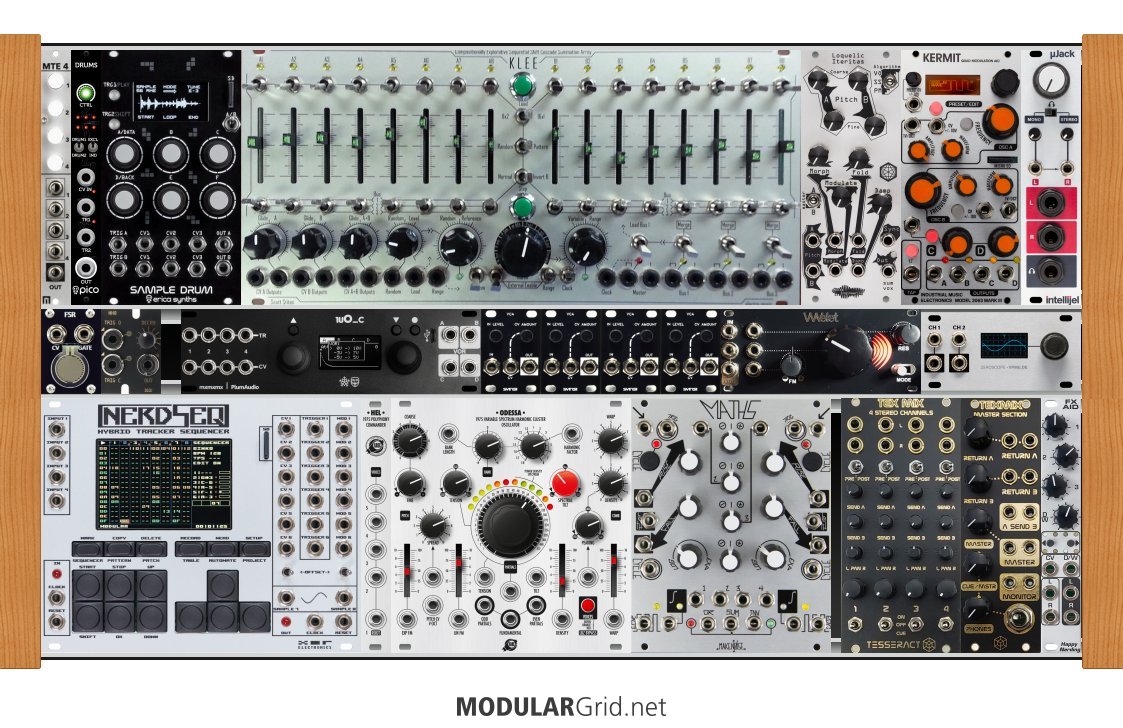
Downsizing and cleaning out. 7u 104hp feels tight but I already bought the case so here we go. Idea here is to use nerdseq to play fixed chord progessions through Odessa expander, while jamming basslines / melodies on Klee, throw in samples and drums. Id like more clock modulation I think.
I haven't found a method of generative chord progressions I like, so I'd like to take fixed structures and break them in real time.
Only non-negotiables here are Klee, Odessa, texmex, o_c, and Kermit. Very curious on any ideas you might have. Thank you.

Howdy folks! I've been tweaking this patch for a week and I've really enjoyed the many forms it has taken to get to this point. This is a performance recording (probably take 5?) and I used the Moog Subharmonicon, MI Rings, VPME.QD, Make Noise XPO, MI Plaits, Qu-Bit Nautilus, Strymon Starlab, Stochastic Inspiration Generator, Rene2, etc. etc. ;-)
I also spent a bunch of time creating the animation in Artmatic Designer. It really is an incredible program for creating these stunning visuals.
Enjoy. Cheers!
https://cdn.modulargrid.net/img/racks/modulargrid_2077374.jpg?1669410001
Updated screenshot -- the one at the top of the thread is from earlier while I was tinkering!
Comments welcome on practicality of setup and order of purchase. I admit I have a steep learning curve as I'm leaping blind into this with no advice or experience, so be brutal and honest please folks.
My aim at the moment is to build a beginner's setup to use mainly as a drone-machine for ambient and industrial music (currently I'm all in the box) but with some capacity for me to also experiment with bleepy electro and basic sound design.
So far I have soe of the plumbing (power, mixer, mult, out) and a cheapo 84hp rack (held nose, bought Behringer). Next up is the Weather Drones as a central unit, plus the ADSR and Quad VCA...
The Takaab RLFO in December, but then I'll be broke af.
The arp and burst generator, which are more geared to the latter aspects of my interests, are going to have to wait until New Year.
Yeah there are weak points in monster case and sometimes it’s hard to get knurlies screwed into parts of the case.
I would buy something like Cases from Lake as my next large format case.

This the best quadraphonic signal processor today (Nov 2022). This module will place one voice in the quadraphonic space using various internal patterns that can be sync to an external clock. Automations can be removed to control via CV the location of the signal using either polar (angle-distance) or cartesian coordinates (x-y).
The strength of this module is because it is tightly integrated with an LFO, which guarantees no audio bleed when the audio signal is abruptly moved from one quadraphonic output to another.
Additionally this module has a configurable output to, for instance, output the distance of the signal to the center. This signal can be send to control the reverb on an input signal. The further the signal is from the center, the more reverb is applied to the audio input, increasing the distance illusion on the final quadraphonic output.
This module can also be used to process mono or stereo, making it a kind of dynamic mixer, input 4 different audio signal and using the sum output get the module to create interesting mixes.
This module gives you many of the capabilities of the Buchla 227e, the reference for quadraphonic, but in Eurorack format. A must have module when starting in quadraphonic.
See more quadraphonic modules at https://www.peachymango.org/EuroQuad

I have a Doepfer Monster Base (the flightcase version), I don't like the angles (the 45° angle doesn't work for my setup) and it turns out to be too wide for my personal eurorack bandwidth... but what I really really like about them is the solid build, the handles, the PSUs and the fact that it has a lid that actually fits snuggly into place. I'm selling the base btw if anyone's interested, it has two PSU2s that were just about enough to handle my requirements.
It's not a good idea to put stress on any PSU, as it might break (no big deal) and take a few modules with it when it dies (probably a big deal).
(I'd stay away from the Meanwells if possible. Many makers (that don't sell PSUs so they aren't trying to sell their stuff to me) have warned me about issues with those. )

The third panel seems to be custom.
Phisynth used to have double this amount, but seems to have cut down. Commenting he really didn't need that much and that this is now about the right size.
"PRO MIX" is actually labelled "CV MIXER" on the custom panel.
Not the usual TKB.
Doepfer monster cases have lids and covers with handles to transport them places. I like the clean aesthetic and power but Case from Lake look fantastic as well.