Hello Forum,

A humble request for advice with some context:

I have a home studio with midi keyboard, Native Instruments Maschine, and a bunch of guitars. I also bought a couple of behringer synths to try and figure out why people prefer physical synth hardware to the DAW life. (It turns out they are both excellent approaches for me).

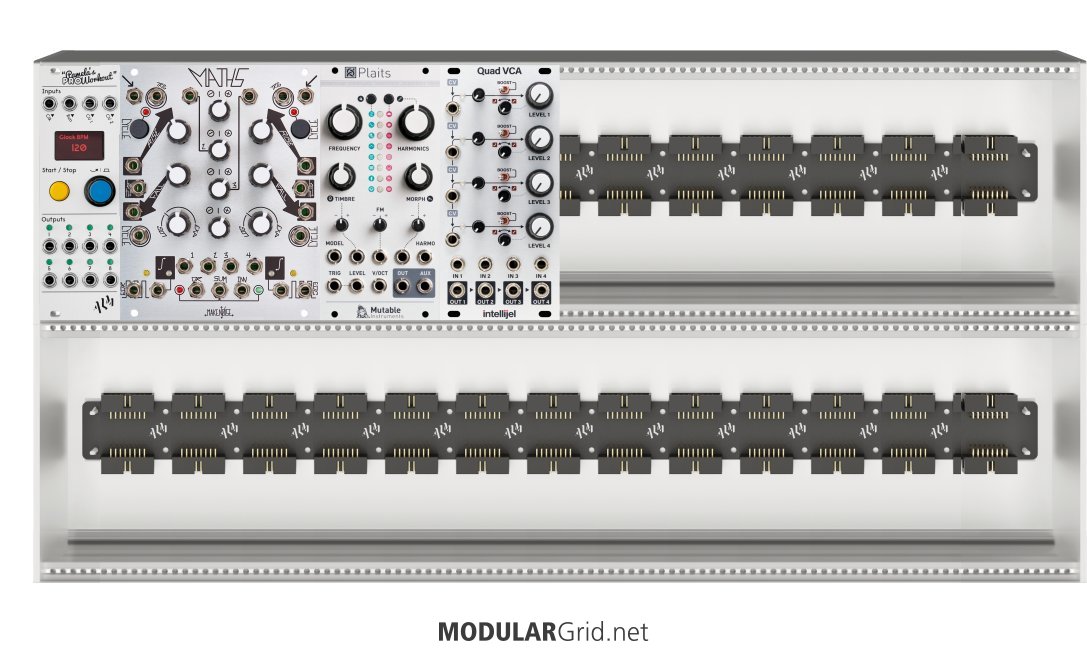
As a hobbyist, I really enjoy the speed of being able to experiment with software synths in my music and now use my midi keyboard to play analog synths. Now for Eurorack...I would like to buy secondhand gear to augment what I can do with Maschine, Kontakt, Logic, and (a very little so far) ableton. I have done a ton of research and am now asking for feedback...**If I want to augment native instruments software suite and record into my computer, is the following sufficient to generate musical, interesting stuff?

ModularGrid Rack

Thanks all for any insights you can provide.

P.


Hi,
welcome! I'll start by asking: are the two hermods a mistake, or were you planning to put both in your rack?
Secondly: do you plan to use eurorack on its own, or in conjunction with your other gear? If so, I think hermod is unnecessary if you plan to use it as a simple midi to cv converter. It is an extremely powerful sequencer, but it's overkill if you only plan to use it for conversion for sequences coming from live/other external devices.
Lastly: do you also have an outboard mixer, or other gear of some sort that you can connect your modular to and bring it into your daw (that also accepts modular level)? If not, I think an output module is also needed.

What you have shown here is absolutely enough to begin your journey. What is and is not interesting is extremely subjective, especially in modular land. Personally, I would add another simple basic analog oscillator, and some more hands on modulation/random. A turing machine and/or the simplest step sequencer you can find. For me, especially in modular land, interesting is very often closely related to unexpected. That's when modular is not a collection of modules, but becomes an instrument in the more traditional sense of the term: something that you have a conversation with, and it has to be able to talk back and not just execute instructions.


Larsech and Forum,

Thanks for the response! The duplicate Hermods were a mistake (I removed the Hermod+ because the original is quite a bit less expensive). I was originally going to put a Mutant Brain midi i/o module in the rack to get a midi signal in, but the price difference between that and a used Hermod seemed small enough that I thought I could get Midi In plus some Midi effects with the Hermod (though I can do everything I read about for midi effects in DAW too). I thought that since it accepts CV in also that I could use it for some kind of sequencing or weirness that I do not yet understand.

Also, you asked about an audio interface...I have an apollo twin that accepts line level, plus a guitar input. I hoped that if I reduce input gain on the apollo, I could probably get by with a signal from the rig without a dedicated output module (though I don't even know what part of the current rig would output into the apollo, frankly.

I have taken your feedback about randomness and an extra oscillator, and made two additions: Marbles (randomness with a gentler learning curve) and Dixie 2+ (well-reviewed analog oscillator).

Here is a link to the updated plan: https://cdn.modulargrid.net/img/racks/modulargrid_3025046.jpg

Questions:
1) Does this look about right in terms of introducing more randomness and oscillator source?
2) Because I can't afford all of this at once, could you suggest a sequence in which to buy so that I can learn as I grow the system? I was thinking Mantis case plus used modules going in order pretty much from left to right, but that is not a very scientific sequencing of module procurement...

Again, thanks for making the time to help a stranger out. Very much appreciated.

P.


Hi there !

As you discuss the Hermod, I wanted to jump in to say that it can do a few more things on top of midi to cv conversion ;)
IMO, it's a beast that can do a lot in a rack, and when I started with a smaller setup, it proved really useful as:
- lfo
- step modulation sequencer/recorder
- euclidian sequences
- random sequences
Biggest downside for me is the limited CV inputs, but I learned to live with it - the modmatrix helps with that. I also read a lot of complaints about the fact that entering notes with the small screen and the single encoder can be a hassle but if you connect any type of midi keyboard to it, it's a breeze (also works with Push sending note info to Hermod through Ableton, if you have that).
And indeed, as you already noted, because the Hermod+ came out, a lot of people (including me, hehe) are selling their Hermod v1 for relatively cheap, making it particularly good value for the money at the moment.

For your other questions, because I 100% agree with Larsech that modular is what you make of it and only you can decide what makes it interesting, I would be tempted to ask question n°1 back at you :-) Does it look useful/fun/playable enough to you ? Marbles if fantastic IMO, but it didn't make my rack because I prefer going about other ways, the question here is will you get what you want from it ? I'd suggest playing with it in VCV and decide for yourself, I think all the Mutable modules are all in the VCV free library (Marbles is Random Sampler by Audible Instruments for example), and playing inside VCV can teach you a lot about what feels fun to you in terms of patching, all for free.

As for your buying sequence, Plaits + Maths + Quad VCA is the barebones version, it will make sound and give you space to explore for a while. Then you can add Hermod if you want to have immediate midi connectivity and loads of other tools and Polaris if you'd like a filter in the rack (you can always use a VST one after your modular when you start if funds are really limited, I guess). I mention the 3 modules version with Plaits + Maths + Quad VCA (or even with Polaris before Hermod) because I think it can also be an interesting creative challenge to learn the modules and have fun while also spending less, I mean Maths is highly praised for good reasons and so is Plaits... My guess is that by the time you have your first 5 modules and have played with them, you'll probably have a good idea of what feels right next...

One last piece of advice, if I may, it's one I hope you've already seen elsewhere but it's very valuable so here it goes again: go slow, keep doing loads of research and learn the modules you already in depth before deciding to buy more. It will save you hard earned money, and make you a better musician with your instrument in my humble opinion. If you think about it, not being able to afford a full rack from the start may be a blessing in disguise ;-)

Hope this helped !

D.

--- Voltage control all the things ---


Both of you guys have helped me immensely. I will start with the most essential few units and figure out how to integrate into my existing DAW + Behringer Model D + CAT stuff before plunging any deeper. I think it is a really good point that more stuff could just mean more overhwhelm as a newbie. Will also do research on all the VCV equivalents so that I can play around with that in software form.

I really appreciate ya'll both taking the time. See you around the forum!

P.