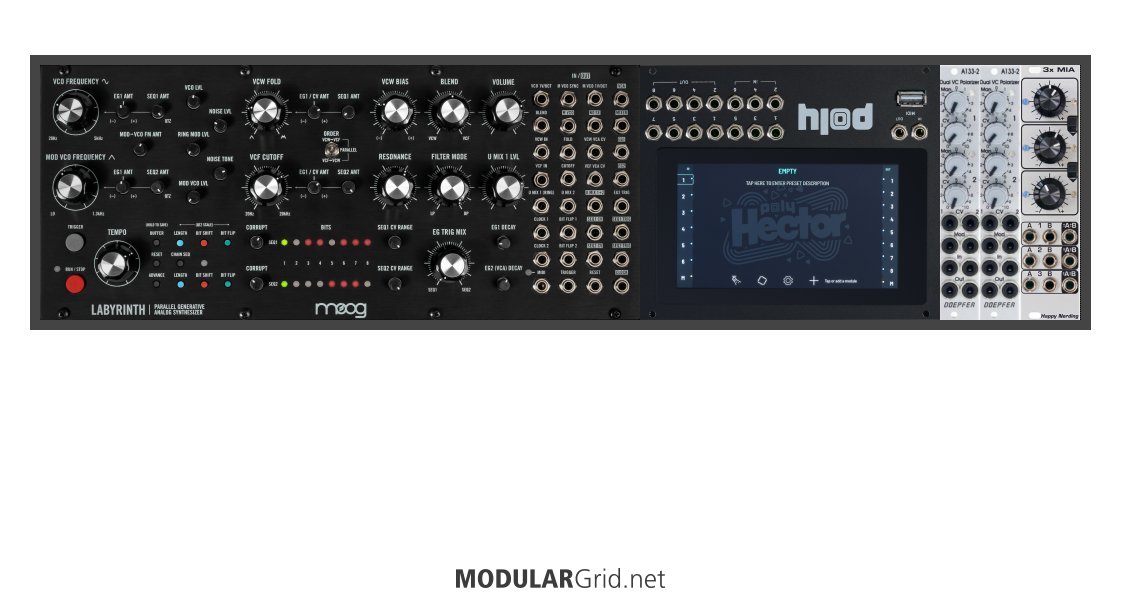
I read line in/ line out on the panel. how is this thought for eurorack?
-- Musicaespressiva2
It's designed to fit in a 3U Eurorack row. There's multiple instances on the site of someone or some company adapting a desktop unit to fit in a Eurorack case, presumably so that the user doesn't have to take up extra room putting the desktop unit somewhere separate, or so that they don't have to have multiple power supplies and worry about a separate box. It's eurorack mainly for the sake of convenience.
Do you have any of these? The easiest way to get going on this and clarify your needs and demands is to just get a couple of the things you absolutely want the most and then figure it out from there. The good thing is that you already have a DFAM and a 0-Coast so you don't need a "basic signal path" to get started. You can just start picking up whatever you want to try that might add to what you already like and want from those. It's not adivisable to get it all at once - something always comes up to complicate things or necessitate a different module be swapped in. (For example, you'll either have to sub in a different low pass gate or hunt one down and likely pay way more than necessary for that LxD, since it's discontinued and sort of a cult item). Doing this gradually will give you more time to think and more trial and error period without the wasted time of selling things that don't make the cut or the overload of learning too many things at once. To me it almost sounds like you should start by experimenting with different logic modules and the like first, since that's the thing you don't currently have and seem most interested in. The oscillators and filters are probably good to have as well (especially the LPG if you want percussion that feels snappy and is easy to set up), but you can already make sounds and probably already understand that side of signal flow.
And pick bigger modules where you can. Not only will you find this cramped, but 2hp modules are just a nightmare to use in general. They work great in terms of their functions as far as I've seen but both the ones I had were tough to fit in a case. That's another issue here. All these small modules are going to create opportunities for ribbon cables and the like to make it harder to fit everything in (even if your case is more than deep enough). Some kickass modules are just small, but this exact functionality would be much easier and better if it took up roughly twice as much space (or more, but don't get too crazy).
I have added a Selecta and a Doepfer Slew Limiter, because they are simple, and looking them up should explain the concept well. You should look into other modules with similar features before making any decision, and don't feel like you need to do it this way. I have also added a breakout for the Beatstep Pro to represent its outputs, but as far as I know, this is not even available and you do not need it.
This is simple enough. You send the sequencer output into the slew limiter and it smooths out the rising and/or falling edges of your signal, making it more wavy and round so it sounds less like a "sequence" and more like an LFO or repeating smooth randomness that you can control with the sequencer knobs. It kinda lets you "draw" modulation in a limited sense.
This is the gates/triggers and envelopes combined in the Selecta. One envelope goes to the VCA so it can be brought down and used for rhythmic variety. The logic circuit combines them in ways where they don't do weird stuff at the moment when both envelopes are still running. The switch section can be used for lots of things, but one potential use is to extend the amount of things to feed into the OR combiner and create something where you can switch between lots of different kinds of gate and trigger patterns. This module is passive, so it only works with positive voltage, but that's fine for gates and output from the Fuji and Pam's. Different kinds of logic will produce different results, so be sure to look into all the different kinds and see what's available (Erica Synths make a Pico module where you can switch between different modes, Instruo has one with a bunch of types and cascading inputs and Takaab makes a collection of logic modules that can be powered from a single cable).
I don't own a Pam's New Workout, so you'll have to kind of imagine from here whether or not it still helps you. I imagine there's plenty it can do in this context, especially since it apparently also just puts out positive voltage, so you can send it to cheap passive modules and see what happens. Obviously, this should just be taken as a rough outline of a way to use these modules and expand them with very minimal extra spending. What happens from here should be determined with a lot of trial and error through experimenting with what you already have here.
Don't expect you'll get this much feedback on most things, either. My job is slow right now. You and Youtube should be able to take it from here.
You can just use the Behringer sequencer and Pam's for clocked and/or stepped modulation. Throw in a slew limiter or two and it gives you a pretty handy way to design modulation. Some cheap logic modules or switches (or a Tesseract Selecta, which has both) will allow you to combine and move through all these gates/triggers/divided clocks in interesting ways, so you can have complex sequence of gate or triggers from the BSP and a simple clock divided counterpoint from the A-160 set up and then switch between having one, the other, both, or neither. It even works on envelopes and other modulation that is positive voltage, so you could do some of the same with the Fuji.
I would humbly like to point out that there is nothing odd about using a low pass gate with a complex oscillator. This is literally one of the main building blocks of west coast style synthesis. I own an Erica Synths Pico System III, and despite it being a compact "higher end of low-budget" synth, it also has two very enjoyable resonant low pass gates that I have found almost irreplacable. I don't know how similar they are to the Black LPG in terms of sound, but they seem similar in function. You should definitely look into multiple types of filter and LPG (including filters that feature a VCA and a filter but offer separate controls, which sounds like it may be something you're into), but the one you have now is theoretically perfectly fine since the complex oscillator offers a variety of timbrial variation options outside of subtractive filtering, and the Erica Synths module does that subtractive filtering anyway.
I agree that two attenuverter modules taking up much space is a lot. One module to consider here is the Happy Nerding 3xMIA, which is very similar to the 321 from Frap Tools except that it has two inputs for each channel, allowing you to either plug two signals in and mix them as well as invert and attenuate them, but still lets you do offsets with any channel that doesn't have a cable plugged in. I had a Frap Tools 321 and while I think it works good, the knobs aren't as fun as they could be and I found I often forgot what was what in terms of the more esoteric functions. The 3xMIA solved both of these things for me. Definitely keep an eye out for other options, though.
Your Befaco Rampage can be patched to be an ADSR, in addition to being two independent AR generators. If you clear out the Black CV Tools, you will have plenty of room to look at a dedicated envelope generator (or even a Mutable Peaks clone with lots of different options to play around with in 4-8 hp - highly recommended as something to look at). However, don't forget that part of the fun of a Rampage or a Maths or a similar Serge type module is that it can do lots of different jobs as long as you don't necessarily need them all at once. When I got my Maths I went through a big list I found of functions and patches for mine to get familiar, and it really keeps me from constantly drooling over modules that do stuff I already have in some form (or makes me more determined to get them once I find I can't get it quite how I want on the function generator).
Your plan works good. My plan might work good. Someone else's plan might work good. Right now, I think going for a filter/lpg and the Rampage (assuming I have understood correctly and you only have the Mindphaser and Niftykeyz currently) next would give you a fully functioning small setup that you could learn a surprising amount of modular basics on and have fun doing so. From there, determining your next move will be much easier, especially if you combine this with researching the different classic module types everyone says you need and figuring out which ones work the best.
I would look into more LFOs and/or function generators for sure, but I would also look into modules that kinda take one or two inputs and turn them into lots of related outputs. In addition to the Multimod mentioned above, examples include:
Mystic Circuits ANA 2
WORNG Vector Space
Ritual Circuits Anima or other shift registers
Black Noise Cosmos
Nonlinearcircuits Let's Splosh
The latter two can be found for free on VCV Rack if you want to play with them. A related but slightly different approach is a joystick module, which is not only just fun in general, but is usually another really interesting way to engage with the modulation you have in a broader, stranger sense.
A quantizer might be good here as well. That way, you can kinda just throw whatever in there and see what melodies come out, and it also gives you more options in terms of creating unique sequences by having your pitch and gate information come from separate sources.
This is a little crazy. but you could always try a module like the ES-8, ES-9, or Boredbrain Optx v2 (if you already have an interface with lots of channels and ADAT) and experiment with a hybrid setup as well (hardware and software modules). Even if it isn't permanent, it may provide some new ideas and let you use some modules you weren't considering before. An interface with DC-coupled outputs will let you send modulation from the computer as well as audio, allowing for full integration of the two sides of your setup.
It seems like you have plenty to work with, but these are my suggestions for how to spice things up.
Castor & Pollux might be difficult because the company is finished making modules, and the used prices for them can be pretty steep.
More importantly, this rack needs modulation. LFOs, sample and hold, random sources, function generators...the more, the merrier. Marbles (chaos) is a good place to start, but this system has ton of sound sources and effects to be modulated, and hitting them with more modulation will make things feel more alive.
It also needs VCAs and/or attenuverters for that modulation or for other routing. Definitely look into the difference to see what would be most useful to you. There's lots of good and interesting small options. The Polivoks one might sound good, and I can't speak for or against it, but smaller and less elaborate VCAs for modulations. It would be worth considering a 3xVCA and 3xMIA or some other VCA/attenuverter situation that works for you.
In terms of the Hive, I do feel like there are other tools that might be more helpful in here than voltage controllable panning, like mutes or even a 4x2 Stereo Matrix Mixer for unique mixing, but you'll know better than me what works best for you in terms of that. How good is the Behringer interface at taking signals from the modular currently? Have you tested this?
I know you said you have a preference for DIY, and that's a good way to go in Eurorack, but it is worth considering that you've sort of painted yourself into a corner by picking a lot of very large sound sources while neglecting modulation and utilities. Now all of the more efficient and feature-packed the modulation and utility modules (digital or analog) that can fit into the space you have left are either too big or not DIY. I don't really have a specific answer to this for you, since my solution would be to get rid of certain things you seem to already have, and I'm not really trying to change your system into something different from what you want. It is worth considering how many other types of module are in here that can make your current modules more flexible and more playable, though. If you had a little more space in here, it would go a long way. Maybe there's room for exploring this in a future iteration of things or a potential expansion.
In the meantime, one potential DIY option to look at is the new Ornament and Crime version that runs 4 apps now instead of 2 and also adds dedicated audio ins and outs. Lots of options to try out there. They say it is a "difficult build", but it might be a fun challenge. The original also has lots of DIY options if you decide that's more chill. Cubusynth makes some interesting kits, and their passive attenuator, quad VCA, and quad VCLFO kits might be of interest to you. Nonlinearcircuits also has some cool stuff, like a Triple Sloths, a triple VCA with lots of features, or their dual LFO/Osc. If you haven't already looked at their website, they have lots of good ideas. I also saw this and thought it might help: https://www.etsy.com/ca/listing/1318579918/froal-quad-function-generator-eurorack
Sounds like a good group. With that many things going on, something like an Ochd+expander would perhaps be helpful, but that's not necessarily obscure and you may very well have considered it already. That's the nice thing about expanding from semi-modulars: they already work, so extending them doesn't really have any requirements as long as you know what you want to do with the other parts.
We've all got the bug in some way. It's why we're here. If you already have the Ringfade, then you might as well put it to use. I also have QPAS and Maths, so I have no complaints about them. Sometimes a big idea needs a big module.
I have the Ochd and the expander. I enjoy them quite a bit. The variety is good, and it can often act as a sort of ambient "sequencer" using the expander's triggers and the slow-stepped noise generators. The lack of knobs isn't as much of a problem as it seems. It's also a nice way to bind lots of things that aren't necessarily related and make them move together. It is also great for feedbacking into itself and making the modulation more unstable and unique. Otterly looks good too, but all these sound sources are going to be very thirsty for modulation, so getting more will be good.
What are you sequencing this with? Pam's? The Keystep Pro? Both?
That Erica Synths ring mod is very big for a case like this. It'll also be hard to find currently. If you know of one you can get and really want it, I can't stop you. I would definitely look at something simpler and smaller there. I'm a big fan of ring modulation as an effect that is well-suited to hardware and Eurorack, but you're trying to fit a lot of sounds and effects in a tight space, and that's space that could be used for attenuverters or something to control signals coming out of modules like the Pam's or the Pons without independent controls for all of them (I would say that's a bigger priority than more VCAs, which can be nice but is not always the best way to manipulate a signal). A module like the Doepfer A-133-2 or the Make Noise Moddemix would free up some much needed HP while still being valuable for both audio and CV processing (after all, ring mods are kind of just bipolar VCAs). I think this might ultimately be a more productive and playable setup than the Ringfade and the 2hp VCA. 2hp modules can be kind of a headache unless they're simple ones without knobs. Ultimately, it's up to you, but when I think that you already have the top row and you particularly want the other two sound sources, the Ringfade and 2hp VCA are the first places I would look to open up some room for a quality of life module like an attenuverter or switch or something else that helps you move signals and ideas through your rack.
The Otterly is not a bad choice. For 8hp, in a system this dense with sound makers and effects, an Ochd plus the expander is also worth considering (24 outputs with a good variety vs. 5 with a bit of flexibility). Either one will do fun and crazy things if you feed the one of the outputs back into the modulation input, so make sure to do that with whichever you choose.
I tend to think 1 sound source and one effect vs modulation and utilities is usually about right in terms of how to allocate space in a rack, but not everyone, including me, follows this in every rack concept. You'll have to decide as time goes on whether or not you've got the right ratio for yourself. Hopefully my suggestions either help you get where you're going regardless of whether it's the places I suggested.
You have an external mixer that can handle this stuff, right? I presume you do if you have the stuff in the first row, but it's worth asking. In-rack mixing is cool for CV and stuff, but unless you get hit bad with the special Eurorack mixer bug, I wouldn't recommend it.
For all the things in that setup, you could probably justify not only the Hermod+ but also its expander, which would give you 32 assignable outputs for gates/triggers or pitch or whatever. This might be more costly than anticipated, but this is a big system with a lot of voices or voicelike elements. Before going that route, you could also use the 8 MIDI tracks, completely separate from the 8 CV/Gate tracks, to sequence the Bitbox (and anything else in the rack via MIDI to CV conversion such as what can be done in o_C.). o_C and Pam's can also fill in some of the drum duties, since they have a variety of sequencing options.
This is a thirsty system, and it will absorb most of what you throw at it. Sequencing for eurorack helps not only with placing drums and melodies, but:
sequencing modulation parameters
changing the state of an effect at a crucial time
sequencing switches/crossfaders/mixers/logic/etc. to switch elements of your patch on the fly
using the more predictable sequencer tracks to clock, manage, and tame other, more boutique sequencer concepts
...and anything else in your system that takes voltage. Plus it spits out LFOs and envelopes, which you will definitely want more of. Overall, I don't think you could overdo the sequencing in there even if you cut out a voice/effect or two to add in some stuff for signal flow and routing. Just be sure to buy things carefully over an extended period and make sure you use the system frequently as it comes together to troubleshoot problems and get the best sense of what is or isn't missing. You never really know what you can and can't do until you sit down with what you have so far, and you only have two hands.
Personally, for all of that plus the modules to sustain it, I would recommend a sequencer with more outputs and tracks, like a Hermod or Hermod+, Nerdseq+trigger expander, Per4mer, Eloquencer, etc. Plug a cheap MIDI keyboard in there for note entry in there and suddenly you've got a lot more going on for almost the same price.
You could get by with the Ground Control, I suppose, particularly if you find a good deal on it and have looked into the workflow to confirm you'll like it. The Pam's will be really important alongside that as well. I don't think Rene 2 can handle the job alone, though it may complement another sequencer very well. A Rene 1 can be found quite cheap to achieve something like this, or you can try the Hemispheres app that roughly emulates it.
Are you planning for this case to be at home or more of a live thing? Do the sounds need to be fairly melodic and gridded, or are you looking for things to be looser and more chaotic? You also have the option of getting MIDI to CV converters and just running this from your computer or other more traditional midi sequencer.
Overall, my personal opinion is that CV/Gate sequencing is better off having a free track or two that can be used to sequence weird stuff to see what happens, as opposed to having not quite enough when you want to do something full and alive with all those sound sources, samples, and triggered drums. If you decide less sequencing and more creative stretching of other modulation for musical results works better for you, that's fair, but it's worth considering - especially when a Ground Control is pretty expensive.
What do you use the most? You should build your live setup around a condensed version whatever it is you do naturally. What's a patch you've done recently that you felt you were able to jam on productively for a while? This might be more of a songwriting challenge than a setup issue.
How do you normally sequence this stuff? Do you plan to have distinct melodies/structures that evolve, or do you usually make your music by just improvising and not worrying about what "song" you're playing? I don't see a dedicated sequencing device on here, and that might streamline this process for you. There are a lot of possibilities in here for sequencing a set like you've described, but as you say, this potential is scattered across various modules without a clearly emerging singular logic. That aspect is extremely personal and will benefit greatly from trial and error that I presume has already started.
Since you know you want acid stuff, start with whatever makes the best and/or largest amount of usable acid sounds for you and go from there. What's your favorite way to put that element in, and how would you generate the pitch and gate info for it?
If you want the MIDI input to work on your Intellijel case, you'll need one of their 1U MIDI output modules to connect to it. If you don't need that, then you're fine, but it might help for sending pitch and gate information to the Crust and its other firmwares (Pizza is a great oscillator, and the Basil is not only a great delay but an interesting Karplus-Strong voice). Unfortunately, there isn't much room for my next suggestion, which would be a hands-on source of free-running modulation (LFO, function generator, etc).
Overall, I think this can absolutely be used as it is, but I am wondering how committed you are to the Palette case. They are pretty expensive and require at least two extra modules (a 1U MIDI out and a 1U stereo out) in order to get all the functionality you need. The 1U modules you've chosen can easily be found in 3U format. In other words, a lot the extras that make this case so expensive don't seem to be a concern for you, unless I am mistaken. Will you be using this alongside MIDI sequencing and mixing things outside of the rack?
I wouldn't recommend more voices. 3 in a system like this is plenty, and havimg enough modulation to move them around is arguably much more important in this format for getting full and complex arrangements. If anything, this is a good reason to keep Maths anyway: if you set one or both sides to cycle and turn the rise and fall way down, they will go at audio rate and function as oscillators. You can have then function normally by using the Both input as your pitch input. You can also have some weird, pitch affected waveshaping by putting the pitch information into just the Rise or Fall input.
All the modulation you can fit in this case is good, and Maths is a versatile module that can cover a lot of ground. Pam's is a good inclusion, too, but the clocked nature of it means you'll want another more free-running, hands-on module to complement it. The logic and mixing elements will also help for making interesting hybrids of these elements. There are other options for complex modulation modules that potentially take up less space (Xaoc Zadar, Intellijel Quadrax, Mutable Peaks, Vostok Fuji), so this is also an option, but Maths can do a bunch of things these can't (like be an oscillator or envelope follower) and is probably more fun in this context.
There are two MIDI input modules here. mmMidi does not do MIDI out. Just MIDI in. You'll need something that explicitly does CV to MIDI conversion. Alternately, you can just use Pam's with its MIDI expander that has a MIDI out, but that will limit you to what you can get out of Pam's (not that this is all that limited). Don't forget that the Arbhar has an expander that allows for polyphonic MIDI input as well. You may not need as much direct MIDI to CV conversion as you think. What else needs to be clocked via MIDI aside from Pam's?
The ALM MCF is pretty much only available in the System Coupe amd doesn't appear to be around anymore. Unless you found one ypu can buy or you already have one, you may need another filter.
Otherwise it all looks fine to me. I'm a big fan of the Aurora, especially because it also has alternate firmware for a slightly more conventional reverb based on FDN, so it can be both its beautiful weird self or a more traditional sounding reverb with modulation if you find yourself needing that in the rack but not wanting to buy a whole other reverb. The Intellijel VCA is a classic and a good call. I'm not crazy about output modules in the rack, and there are 0hp options (I have a nice one from Herzlich labs), but if you think having one in there will help, I say go for it.
If you need more space, don't be afraid to put the Mother-32 back in its own case. It seems like a good balance to me for now (you don't need much to get a Moog, a granular synth, and another oscillator to form a full arrangement), but temptation is always there and you do have some wiggle room if something comes up.
I can't really imagine how a ban is not appropriate here. If they aren't going to be banned, then I guess that means they're allowed to do this in a context where we can respond freely.
While you're picking up little Takaab modules, I would recommend a 2LPG. It might open up what kind of oscillators and sounds you can use as percussion, and it's cheap, small, and passive.
Not the most creative, but very practical because you can buy it in stages (Labyrinth has its own case, Hector (has its own case), case/utilities). Plus, as you learn more about specific modules and get more stuff (if you do), these will still be useful, and you can out them back in their own cases and use the space for more stuff.
The Hector is a suggestion I go to because it has so many Mutable Instruments modules ported to it. Marbles and Grids are great generative sequencers that are both there with great interfaces. It also has great effects and synth sounds from Mutable (and in general) that will work with the Labyrinth and cover areas it can't (as the Labyrinth does for the Hector with its filter, oscillators, and hands-on elements).
But, of course, make sure you do some research, play with VCV Rack or Hexen, and narrow things down so you know what you want and why when you start spending. There are a lot of ways to do generative modular – it's one of the things the medium does best.
Not that I can comment on everything but spotted your 'No Effects', I keep a 2HP Verb in my percussion case for Hats & Claps I find it just finished off the sound nicely when you need it and it obviously only takes up 2hp.
-- wishbonebrewery
It kind of just seems like you wanted only compliments and no criticism, which was not going to happen because people were under the impression you were going to buy this stuff, and if people's differing opinons could dissuade you this easily, your concept may not have been as sturdy as you thought. If you get advice you don't need, just ignore it. You don't have to argue against their vision. It doesn't cancel yours out somehow.
I am no more certain of what your goal is here than I was a year ago, but I am more suspicious than ever that something more than trolling is going on. Probably nothing of importance, really, but that just makes it even more confusing.
I would have, if i was ready to start planning a case, but it is a detail that i was confused about, that you missed an opportunity to help clarify for me, that if there was an on site bot that I could dialogue with, that i asked for help putting things together, could have just resolved this in the natural flow of things. I came on here as a noob wanting to bounce around ideas about design concepts and was treated with hostility. AI would have had emotional sensitivity training. What the eff makes you still think that there is zero chance I will ever become a modular performer @zacksname , its just disrespect.
(I did google it. Google actually did give me the right answer as the first result, which i wasnt expecting, because tbh i barely trust Google anymore, but, Fair Point. Etcetera.)
-- singular_sound
You 100% brought the hostility to the situation. Multiple people gave you considered advice on your designs and you just got more and more resentful of the fact they told you things you didn't want to hear.
Did you look up different cases over the past year you've been working on this? I seem to recall you constantly making 100hp racks, so I figured you planned to make the case yourself. I think it's more fair to say you didn't look this up or ask than it is to say you were confused about it.
Can you show me where I said you didn't belong here? I get the feeling that "basically literally" is doing a lot of work to qualify your statement.
A wavefolder? Definitely a big part of the Buchla sound, and it'll be perfect for those 258t sine waves. Intellijel make a pretty fun one, the Bifold, but there are multiple options.
A 296-style resonant filter bank/EQ? That's a pretty classic west coast design. The Buchla one may not fit, but the Serge or Erica Synths ones will. ADDAC also makes a triple bandpass filter like the one Buchla makes for their 4U systems, which might be a more useful version of the concept for you.
Some of the recent module concepts from Tiptop like the programmable pulser or the frequency shifter might be fun here.
I thought you wanted people to engage with you. I'm the only one still willing to do so, and I've been as reasonable as anyone could be about all this. If you don't want to talk to me, that's fine, but if you don't like what I've said then there might not be a point for you in coming here to engage, especially if you continue to be combative about any advice that conflicts with your idealized version of modular synths.