IDM / generative drum rack with Metron — learning probability, CV processing, and controlled chaos

Hello everyone,

I recently moved my main system into an Erica Synths Mega Case, which leaves me with a spare Pittsburgh Modular EP-270 that I’d like to turn into a dedicated drum rack.

I produce IDM / electronic / acid / techno, and I want this case to be a performance-focused drum instrument with probability, glitchy rhythms, and evolving patterns. I’m intentionally trying to learn how CV processing, logic, and generative systems work rather than just assembling a static drum machine.

My plan is to use Metron as the primary sequencer, handling core patterns and probabilities, but then heavily process its outputs to introduce variation, fills, density changes, and “controlled chaos.” I’m interested in both per-step probability and CV-driven probability/modulation.

Here’s the rack concept I’m currently sketching:
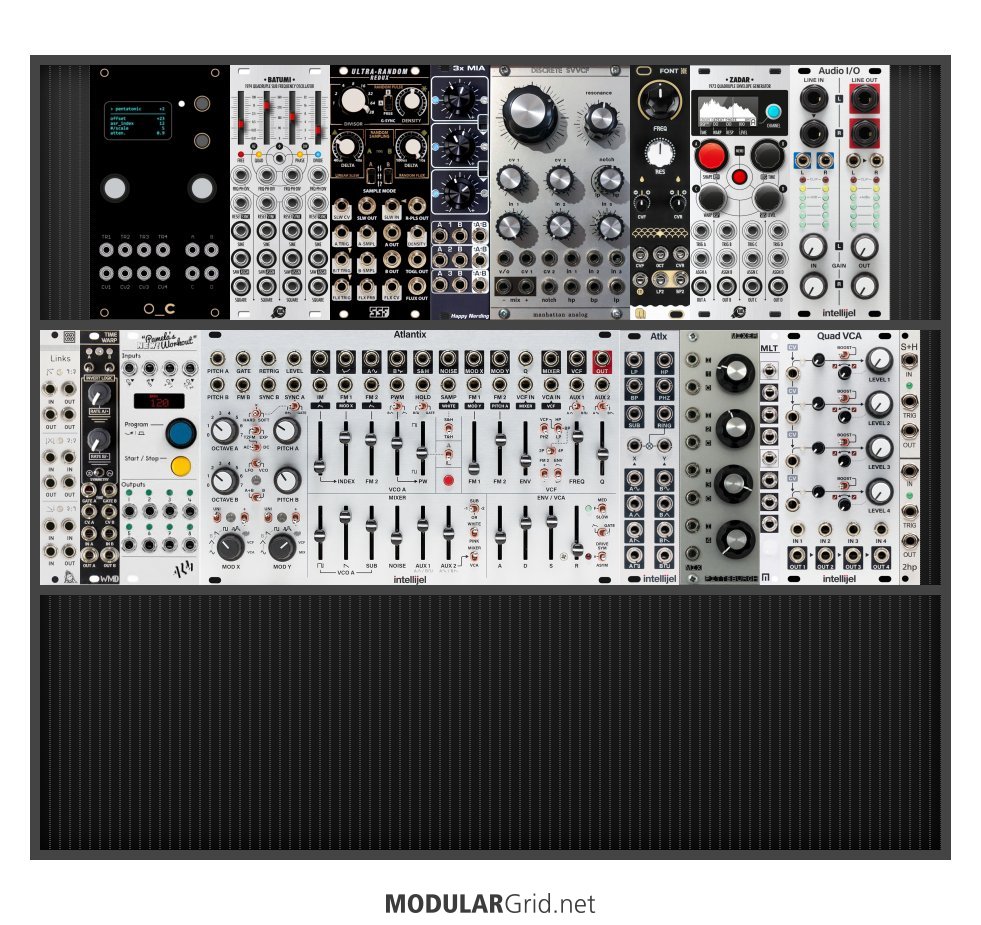
ModularGrid Rack

Drum voices I’m planning around so far:
• Battering Ram
• Jomox ModBase 09 MkII
• Trinity 2.0
• Plonk
• Tiptop Audio 808 Hats
• Tiptop Audio 909 Hats
• Tiptop Audio 808 Snare
• Tiptop Audio 909 Cymbal

Metron would be the main sequencer, and I want to process it with IDUM (and likely other modules), but I’m not yet sure what the right supporting ecosystem looks like.

Things I’m specifically hoping to learn / get advice on:
• What kinds of CV processors, logic, switches, random sources, and utilities pair best with Metron for IDM-style drums?
• Where do people typically introduce probability and variation:
at the sequencer, via trigger processing, via CV modulation, or all three?
• How do you add glitch, fills, and rhythmic mutation without the groove falling apart?
• What’s a good balance between drum voices vs. “plumbing” in a dedicated drum case?
• Any recommended patching concepts for steering generative drums live (macros, performance gestures, density control, etc.)?

This rack will usually be clocked externally, not the master.

I’m very open to being told I’m overthinking things or missing obvious fundamentals — the main goal here is to actually understand how generative / CV-driven drum systems work in practice.

Thanks in advance, and I really appreciate any guidance or patching philosophy you’re willing to share.


Pamelas Pro workout + Axon 2 expander
can do much stuff on its own to sequence and modulate drums - even logic, cross modulating channels, euclidean etc
The cross modulation option of channels (like max of ch 1 and 2 or min of 5 and 7 .... are awesome for drums)

Another idea is - Acid Rain Constellation - you can stack patterns to get new ones wth logic, euclidean, bursts and stuff

Noise enginnering JamJam is cool and small hp fpr probality and gate delay (also to run several sequencers)

I like Bastl Aikido as drum mixer with sidechain (you can moulate rhythmically)
or a befaco percall with noise sources to get glitchy beats

Clank Chaos - can be nice for extreme random and glitch on drums, but it can also be just chaos
shift register modules work well, even a marbles or turing machine with expanders
Benjolin can also do nice rhytmic stuff

Ana 2 - from mystic circus is a swiss army knife for logic (well paired with maths and stuff)
Black noise cosmos is aso nice for logic and also audio processing

Schlappi Engineering NIbbler + BTMX + BTFLD are very useful to sequence nice grooves with logic combinations

mixing gates with a matrix mixer is fun (also adding unsynced lfos, random and stuff, to your patterns)

combining different sequencers and to mix their outputs with matrix mixers and logic modules can be cool
(sequencing) your sequencers can be fun

things like window comperters like Compare 2

picking drums is a matter of taste but:
I go for: SSF Ultra Perc (percussion) + SSF Metalloid (hats) +SSF Ultra kick or Battering Ram as (kick)
It gives me drums which doesnt need much processing to sound awesome - with a very wide range of sounds - its all covered with just 3 modules

Greetings

Chris


hey Chris thanks so much for your detailed response. I'm checking out all of the modules you recommended. That was very helpful.

One thing I didn’t originally ask in my post (and probably should have) is about audio routing and multitracking. My ideal end goal is to be able to record each drum voice separately into my DAW so I can do detailed mixing and processing there, rather than committing to a summed mix inside the rack.

Because of that, I’m a bit unsure how modules like Aikido (which I do like conceptually) fit into that picture, since they seem more performance / submix-oriented. I did try going the ES-9 route for multitrack capture, but I’m already using an SSL 18 as my main interface and couldn’t get the two to play nicely together, so I’m rethinking the overall approach.

So I’m curious how you handle this in practice:
• Do you typically multitrack individual drum voices into a DAW, or commit to submixes?
• Are you using an interface module, external interface inputs, or something else entirely?
• If you’re recording drums, where in your system does “mixing” actually happen for you: in-rack, in the DAW, or both?

I’m trying to avoid overbuilding something that’s great for jamming but awkward for recording, so any insight into how you balance sequencing/logic fun with clean multitrack capture would be hugely appreciated.

Thanks again — your reply already helped me reframe a lot of this.


I do mostly all mixing, processing and effects in the rack.
(just recording the mix in my audio interface)
I like it because I found a way of analog processing in my rack, that sounds good to me - and more special than processed in my daw.

But at the moment:
I also use a module that acts as multitrack recorder - "Half-Time-Modular 8TR"
I record my jams on it, drop the SD card later on my computer and use the seperate stems in the DAW.

  • so I have both - the individual stems and the whole mix with analog processing.

But there are many possibillities and ways to go,

People say that ES 9 is hard to setup - but once you got it running, it works.
But I never tried one.

Some people use a tascam mixer with multitrackrecording
A 1010 bluebox as module or desktop can be a solution - to mix and record

For routing - I keep it very simple -
Aikido acts as my drum bus, (with some saturation, compression, filtering and ducked feedback with other modules like dark matter, MSCL, 100 grit and more.....)
I take a copy of each channel to record the dry and wet audio of each channel with the 8TR.

Greetings

Chris