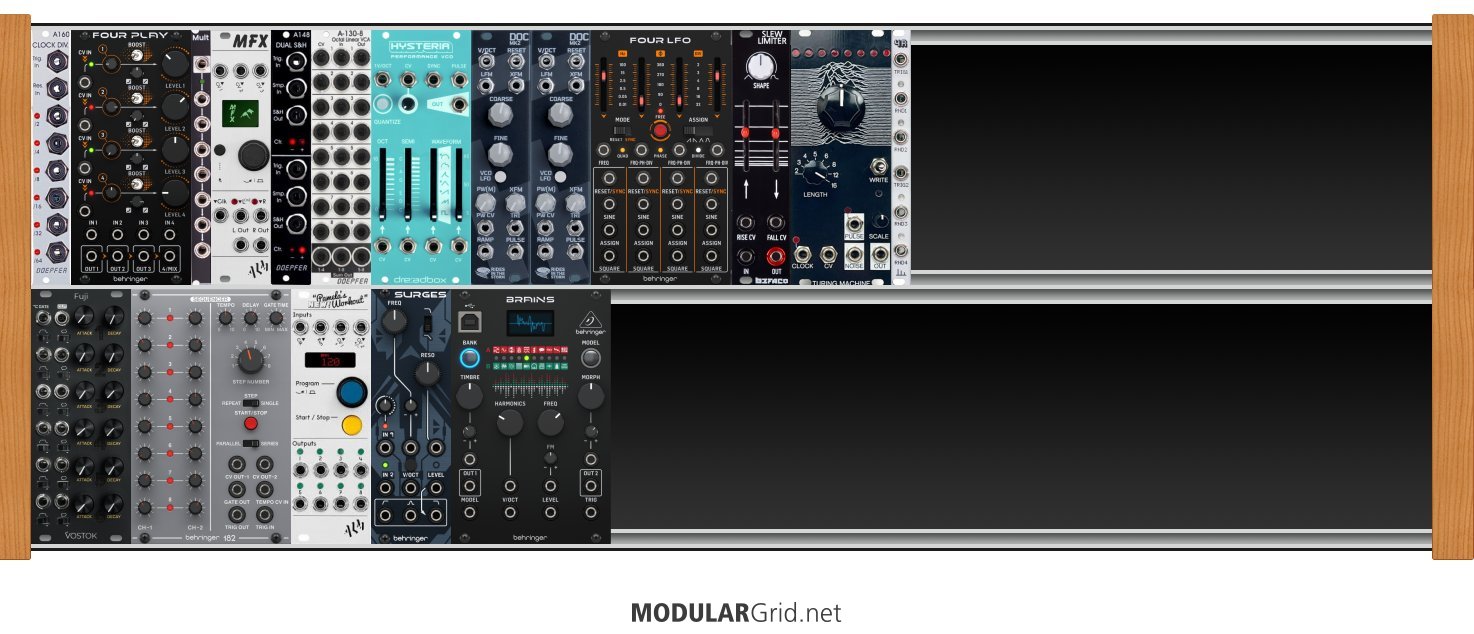
i just got a beatstep pro, and now i'm starting to worry if some of these modules are now useless in my rack. can anyone suggest some inventive ways of using them with my sequencer?

i just got a beatstep pro, and now i'm starting to worry if some of these modules are now useless in my rack. can anyone suggest some inventive ways of using them with my sequencer?

You can just use the Behringer sequencer and Pam's for clocked and/or stepped modulation. Throw in a slew limiter or two and it gives you a pretty handy way to design modulation. Some cheap logic modules or switches (or a Tesseract Selecta, which has both) will allow you to combine and move through all these gates/triggers/divided clocks in interesting ways, so you can have complex sequence of gate or triggers from the BSP and a simple clock divided counterpoint from the A-160 set up and then switch between having one, the other, both, or neither. It even works on envelopes and other modulation that is positive voltage, so you could do some of the same with the Fuji.
You could also just sell them. Whichever works.
thanks, mate. if its not too much bother, could you design a patch on the rack to show me what you mean? i think you can do that on here.
also, did you see the news? the UK's sending a synth-head to eurovision! rejoice!
thanks,
a.d

@ArthurGeddon All the fun in modular is in experimentation ;) But how about you start with this: The Beatstep provides Gate and Pitch information to your synth voice (Brains through Mr. Philter, for example). It triggers the envelope of the Mr. Philter and the envelope opens the filter section. Now, how about you also patch the Gate from the Beatstep to the trigger input of the 182 Sequencer (through the multiple in your top row). Patch the envelope output from the Philter into a VCA channel on the Four Play and the CV1 output from the 182 into the corresponding CV input on the Four Play. Then patch the output of that channel into the filter section on Mr. Philter.
The 182 now controls how much the envelope opens the filter on each step. You can create accents and emphasize certain notes, which makes a sequence much more interesting. Think of the Beatstep as your basic Pitch/Gate information and the 182 as the "spice" you add by sequencing parameters that shape the timbre of your sound or modify the way the basic sequence is transmitted to your sound sources.

Keep in mind: sequencers don't have to sequence pitch. Especially given the fact that you don't appear to have a quantizer in this rack, that behringer sequencer might be better suited to more timbral modulation in your rack.
Use one output of Pam's to provide the Clock In to the Beatstep (it probably wants 24 PPQ), the rest can provide either temo-synced LFOs or "weird clocks" using euclidean rythms and/or logic combinations between outputs. You can use those "weird clocks" to drive your in-rack sequencer, so that it's twiddling knobs in a way not directly related to what the Beatstep is doing.
I have added a Selecta and a Doepfer Slew Limiter, because they are simple, and looking them up should explain the concept well. You should look into other modules with similar features before making any decision, and don't feel like you need to do it this way. I have also added a breakout for the Beatstep Pro to represent its outputs, but as far as I know, this is not even available and you do not need it.
https://cdn.modulargrid.net/img/patches/modulargrid_133545.jpg
This is simple enough. You send the sequencer output into the slew limiter and it smooths out the rising and/or falling edges of your signal, making it more wavy and round so it sounds less like a "sequence" and more like an LFO or repeating smooth randomness that you can control with the sequencer knobs. It kinda lets you "draw" modulation in a limited sense.
https://cdn.modulargrid.net/img/patches/modulargrid_133546.jpg
This is the gates/triggers and envelopes combined in the Selecta. One envelope goes to the VCA so it can be brought down and used for rhythmic variety. The logic circuit combines them in ways where they don't do weird stuff at the moment when both envelopes are still running. The switch section can be used for lots of things, but one potential use is to extend the amount of things to feed into the OR combiner and create something where you can switch between lots of different kinds of gate and trigger patterns. This module is passive, so it only works with positive voltage, but that's fine for gates and output from the Fuji and Pam's. Different kinds of logic will produce different results, so be sure to look into all the different kinds and see what's available (Erica Synths make a Pico module where you can switch between different modes, Instruo has one with a bunch of types and cascading inputs and Takaab makes a collection of logic modules that can be powered from a single cable).
I don't own a Pam's New Workout, so you'll have to kind of imagine from here whether or not it still helps you. I imagine there's plenty it can do in this context, especially since it apparently also just puts out positive voltage, so you can send it to cheap passive modules and see what happens. Obviously, this should just be taken as a rough outline of a way to use these modules and expand them with very minimal extra spending. What happens from here should be determined with a lot of trial and error through experimenting with what you already have here.
Don't expect you'll get this much feedback on most things, either. My job is slow right now. You and Youtube should be able to take it from here.