GravityForge by Voltage Foundry Modular
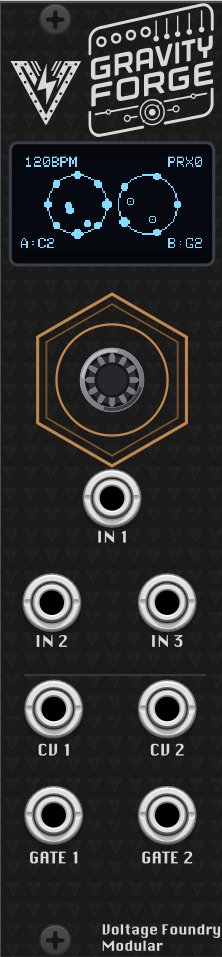
- Dimensions
- 6 HP
- 40 mm deep
- Current Draw
- 60 mA +12V
- 10 mA -12V
- 0 mA 5V
- Price
Available as an assembled Module and as a DIY project.
This Module is currently available.
MG ID: 59062
Dual physics-based generative sequencer
GravityForge is a dual physics-based generative sequencer. Two virtual containers hold bouncing balls. Gravity pulls them down, the containers rotate, and every time a ball strikes one of the pegs ringing a container wall, that peg plays a note.
Each peg is a note. The ring is laid out in ascending pitch, and every peg is a degree of the container's selected scale — so where a ball happens to land decides what you hear, and nothing it can hit is out of key. Two controls shape that ring: SPREAD sets how many octaves it covers (1 to 5), and BIAS decides whether the notes are spaced evenly around it or crowd into the low or the high end. The peg count (3 to 16) then sets how finely that span is divided: a few pegs give wide intervals and an angular, arpeggio-like melody, while a full ring of sixteen gives small steps and something closer to a run. Individual pegs can be muted to open holes in the pattern — a muted peg still bounces the ball, it just stays silent.
Because the balls are never stepped by a clock, the notes land where the physics puts them: a rhythm that is repetitive enough to feel composed but never quite loops.
The signature control is PROXIMITY: the two containers are drawn side by side and a single parameter slides them together. Apart, they are two independent sequencers. Overlapping, a collision in one shoves the balls in the other and rings a peg on its rim. Fully merged, they share one space. It is one continuous knob from "two sequencers" to "one entangled instrument", and you can watch it happening on the screen.
Marketplace sell and buy used modules
Right Now on eBay