

PT Delay Standard 2016
BugBrand
This offer was fetched from reverb.com. You cannot contact the seller via ModularGrid. You have to visit their site.
Look up onOffer Details
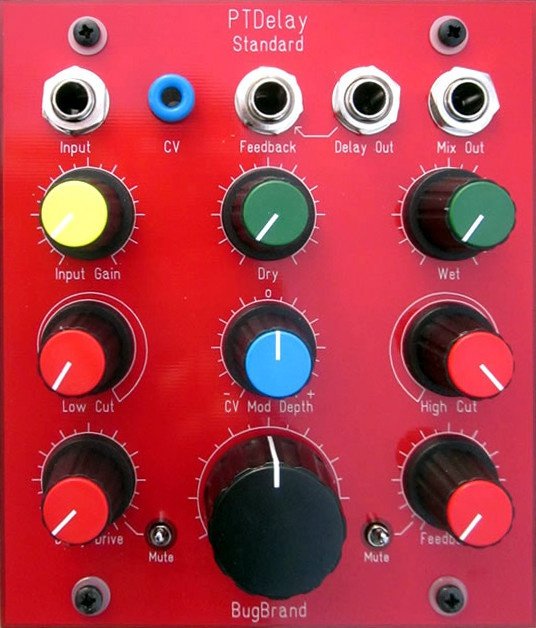
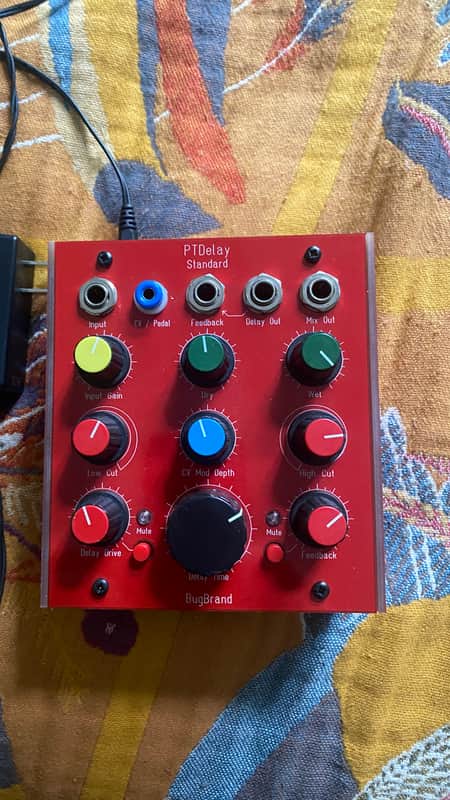
The PT Delay does not aim to compete with clever modern delays (so no microprocessor, tap-tempo, beat-sync, etc.) and instead presents a unique hands-on affair for textural sonic play. With soft-clipping stages, voltage-controlled delay time, powerful equalisation and a true analogue approach, the PT Delay can produce tones akin to tape delays or gnarl down into degraded digital territories. Stand distinct!The first PT Delay was released in 2011 before being reborn as the first ‘Red’ design in 2013. Subsequently it has had a few design tweaks with updated versions appearing in 2015 and then 2018. The ‘Standard’ in the name hints that someday there may be a ‘Deluxe’ version – having said that in 2013, I wouldn’t hold your breath, even if I do know roughly what form it might take.Input Section: Designed for typical line level signals with variable amplification up to 20dB. The input features the first of three LED saturation / soft-clip stages – these stages aim to keep internal signal levels to a standardised level so that, for example, overloading the feedback doesn’t cause dramatic level changes (instead it overloads into sonic wonders, but without the amplitude running crazy). These clip stages can definitely be used for creative explorations.Delay Drive / Feedback: Two controls to determine what goes into the Delay Core, each with Mute switch. The Delay Drive allows bursts of the input sound to be thrown in in true dub-style, while the Feedback (normalised from Delay Out) takes you from single repeat, through washy feedback and into overload.Voltage Controlled Delay Core: Delay time is set by a combination of the main Delay Time dial summed with any external Control Voltage (CV) from the CV Input and CV Mod Depth control with polarity switch. The main control covers times from 35mS to 2.0S, but external CV can take the time longer (up to total digital jittery stop). Delays up to about 300mS (around 1 o’clock on the main dial) are quite clean and from there the digital artefacts start to increase.The 4mm banana CV input is designed for signals from sources such as Modular Synths (typical 5 to 10V p-to-p levels) – the response is not 1V/Oct for sure! I can supply Interface Cables if required.EQ: Low and High cut filtering follows the Delay core – tonally shaping the signals and resulting feedback behaviour.Output Section: The main output comes from a mix of Dry and Delayed (Wet) signals. There is also an output of just the Delayed signal which is normalised to the Feedback input – you can insert further external processing here to alter feedback behaviour.INSTRUCTIONS (PDF)Technical Specifications:Input – Mono balanced 1/4″ Jack – impedance 20k OhmsOutputs – Mono Impedance-balanced 1/4″ Jack – impedance 100 OhmsCV – 4mm Banana – impedance 100k OhmsPower – 12V DC 300mA supply, centre-positive, 2.1mm connector.(worldwide 90-240VAC wall-wart provided with interchangeable mains plug adaptors)The PTDelay is enclosed in a custom aluminium case (based on the Modular line) with PCB material front and side panels. It is a ‘module’ so will happily slot into the Powered Frame.Dimensions approx 5.25″ x 5″ x 3.5
Used Price History
If you had an Unicorn Account you could see a chart with the price development of this module and the average price asked for this module.
About the Unicorn Account